As progressives, we are often given (and give) the impression that once the Cheney/Rumsfeld/Bush troika are defeated, then things can go back to normal and we progressives can renew our battles with the success they formerly met. In fact, this is probably as much an illusion as the wonderworld that the troika tries to paint. What this ignores is that most of us are former progressives who became involved with the pro-business culture of the eighties and nineties, sparked by the explosion in information technologies. This industry has two characteristics that make it hostile to progressive politics, though one might suppose otherwise when its origins are considered. First, to keep up with this industry, even post-boom, requires the dedication of a monk. No one who is not willing to commit themselves 24X7 to enhancing their skills and understanding will be able to survive for long. Being a technologist is largely a matter of facing one crisis and revolution after another - it is almost a pure case of Darwinian capitalist exploitation. Of course, it's supposed to be exciting and fulfilling to do technology all the time, but in reality this is true in most cases only for the very young. Therefore, it is physically impossible for those who work in this industry to spare time for progressive activities. Secondly, the very subject causes attention to be focused on purely technical issues, as if they were the heart of life. It tends to abstract and objectify human problems into a set of technical specifications which can be solved by the application of well-known techniques. We make money when that situation is true, so we are highly motivated to believe it is so. The entrepeneurial push of most technology companies strongly reinforces the culture of individual superiority and the elimination of cooperation.
Consider, for instance, the willingness of Yahoo, Google and MSN to filter search engine traffic for anything that might offend the political sensibility of the Chinese segment of the empire. I don't think we should be surprised when many of the sources of Internet news that progressives depend on suddenly and mysteriously start disappearing. The technological revolutionaries have demonstrated their commitment to profit and their willingness to cooperate with the forces that guarantee that profit. Their supposed commitment to progressive values (usually with the qualification 'libertarian') is much shakier.
Saturday, May 27, 2006


The Party of Death
"God, you are known throughout Judah, Israel glories in your name.
Your tent is pitched in Salem, your command post on Zion.
There you break flaming arrows, shield and sword and war itself!
Majestic and circled with light, you seize your prey; stouthearted soldiers
are stripped of their plunder.
Dazed, they cannot lift a hand.
At your battle cry, God of Jacob, horse and rider are stunned.
You, the one who strikes fear; who can stand up to your anger!
Your verdict sounds from heaven; earth reels, then is still, when you stand as judge
to defend the oppressed." - Psalm 76.
"In the first minutes after the shock of the blast, residents said, silence reigned on the street of walled courtyards, brick homes and tiny palm groves. Marines appeared stunned, or purposeful, as they moved around the burning Humvee, witnesses said.
Then one of the Marines took charge and began shouting, said Fahmi, who was watching from his roof. Fahmi said he saw the Marine direct other Marines into the house closest to the blast, about 50 yards away.
It was the home of 76-year-old Abdul Hamid Hassan Ali. Although he had used a wheelchair since diabetes forced a leg amputation years ago, Ali was always one of the first on his block to go out every morning, scattering scraps for his chickens and hosing the dust of the arid western town from his driveway, neighbors said.
In the house with Ali and his 66-year-old wife, Khamisa Tuma Ali, were three of the middle-aged male members of their family, at least one daughter-in-law and four children -- 4-year-old Abdullah, 8-year-old Iman, 5-year-old Abdul Rahman and 2-month-old Asia.
Marines entered shooting, witnesses recalled. Most of the shots -- in Ali's house and two others -- were fired at such close range that they went through the bodies of the family members and plowed into walls or the floor, physicians at Haditha's hospital said.
A daughter-in-law, identified as Hibbah, escaped with Asia, survivors and neighbors said. Iman and Abdul Rahman were shot but survived. Four-year-old Abdullah, Ali and the rest died.
Ali took nine rounds in the chest and abdomen, leaving his intestines spilling out of the exit wounds in his back, according to his death certificate.
The Marines moved to the house next door, Fahmi said.
Inside were 43-year-old Khafif, 41-year-old Aeda Yasin Ahmed, an 8-year-old son, five young daughters and a 1-year-old girl staying with the family, according to death certificates and neighbors.
The Marines shot them at close range and hurled grenades into the kitchen and bathroom, survivors and neighbors said later. Khafif's pleas could be heard across the neighborhood. Four of the girls died screaming.
Only 13-year-old Safa Younis lived -- saved, she said, by her mother's blood spilling onto her, making her look dead when she fell, limp, in a faint.
Townspeople led a Washington Post reporter this week to the girl they identified as Safa. Wearing a ponytail and tracksuit, the girl said her mother died trying to gather the girls. The girl burst into tears after a few words. The older couple caring for her apologized and asked the reporter to leave.
Moving to a third house in the row, Marines burst in on four brothers, Marwan, Qahtan, Chasib and Jamal Ahmed. Neighbors said the Marines killed them together.
Marine officials said later that one of the brothers had the only gun found among the three families, although there has been no known allegation that the weapon was fired."
"Just because I believe in the 'resurrection of the dead and the life of the world to come' I must already resist the forces of death and annihilation here and now, and must love life here on earth so much that I try with everything I have to free it from exploitation, oppression and alienation. And the opposite is equally true because I love life, and stand up for its justice, and fight for its freedom wherever it is threatened, I hope that one day death will be swallowed up in the victory of life, and that then 'there will be no mourning nor crying nor pain any more' (Rev. 21:4)" - Jurgen Moltmann.
The forces of death crowd into our hearts every day. I do not excuse the soldiers who carried out this bloody and unjustified massacre, but many of us can recognize the forces that drove them to it - the forces that so easily drive us. The tension straps us into our societal binding - the slightest resistance causes chafing. Every minute, we wonder if a sudden explosion at work will mean an end to all the dreams of our life. We fight without ceasing to preserve a pool of hope that is constantly drying out. Then the explosion comes and the tightness of the binding gives way. We shout - we are momentarily loosed from the bonds that make us see human beings in the faces of others. We become agents of another - our fingers now owned by the machine twitch and twitch and the children die. God save us from the body of this death!
The principal to keep hold of in the face of such massacres is to recognize that what they have done cannot be isolated, much as the military court system and our news media will attempt to do. Their first impulse is to rope off this "incident" (that they were unable to cover up) and point to it as a legal problem. It is not a legal problem - it is part of a much larger picture that includes our own assent to violence in the wake of 9/11. Of course, the picture is much larger than even that. Just as in Vietnam, those soldiers were acting out of a hidden consensus that fundamentally approves of violence and seems incapable of grasping that all violence involves injustice, lies, and oppression. Soldiers are conditioned to be as violent as possible, yet they are told that they must obey rules. But rules turn to dust before the fundamental forces that drove them into the "theatre of war" in the first place. Those forces are the falsehoods that now must be covered up with violence. No matter what the rules say, these men were indeed obeying their master.
"The trouble with violence is that it changes not too much, but too little. Nonviolence is more radical because it is more truthful. Violence always ends up calling on lies to defend it, just as lies call on violence to defend them. By contrast, truth is naked, vulnerable as Christ, its only weapon Christ's own, God's love. So the very love of God that found oppression, poverty, and corruption intolerable, this same love, rather than inflict suffering - even on those imposing it on the poor - took suffering upon itself. What can only be said cynically of another - 'It is better that one man should die than that an entire nation perish' (ah, the demands of national security!) - can be said in utter truthfulness about oneself: 'It is better that I should die rather than a single other person perish.' That's finally how truth disarms, and there is no better way." - William Sloan Coffin.
Your tent is pitched in Salem, your command post on Zion.
There you break flaming arrows, shield and sword and war itself!
Majestic and circled with light, you seize your prey; stouthearted soldiers
are stripped of their plunder.
Dazed, they cannot lift a hand.
At your battle cry, God of Jacob, horse and rider are stunned.
You, the one who strikes fear; who can stand up to your anger!
Your verdict sounds from heaven; earth reels, then is still, when you stand as judge
to defend the oppressed." - Psalm 76.
"In the first minutes after the shock of the blast, residents said, silence reigned on the street of walled courtyards, brick homes and tiny palm groves. Marines appeared stunned, or purposeful, as they moved around the burning Humvee, witnesses said.
Then one of the Marines took charge and began shouting, said Fahmi, who was watching from his roof. Fahmi said he saw the Marine direct other Marines into the house closest to the blast, about 50 yards away.
It was the home of 76-year-old Abdul Hamid Hassan Ali. Although he had used a wheelchair since diabetes forced a leg amputation years ago, Ali was always one of the first on his block to go out every morning, scattering scraps for his chickens and hosing the dust of the arid western town from his driveway, neighbors said.
In the house with Ali and his 66-year-old wife, Khamisa Tuma Ali, were three of the middle-aged male members of their family, at least one daughter-in-law and four children -- 4-year-old Abdullah, 8-year-old Iman, 5-year-old Abdul Rahman and 2-month-old Asia.
Marines entered shooting, witnesses recalled. Most of the shots -- in Ali's house and two others -- were fired at such close range that they went through the bodies of the family members and plowed into walls or the floor, physicians at Haditha's hospital said.
A daughter-in-law, identified as Hibbah, escaped with Asia, survivors and neighbors said. Iman and Abdul Rahman were shot but survived. Four-year-old Abdullah, Ali and the rest died.
Ali took nine rounds in the chest and abdomen, leaving his intestines spilling out of the exit wounds in his back, according to his death certificate.
The Marines moved to the house next door, Fahmi said.
Inside were 43-year-old Khafif, 41-year-old Aeda Yasin Ahmed, an 8-year-old son, five young daughters and a 1-year-old girl staying with the family, according to death certificates and neighbors.
The Marines shot them at close range and hurled grenades into the kitchen and bathroom, survivors and neighbors said later. Khafif's pleas could be heard across the neighborhood. Four of the girls died screaming.
Only 13-year-old Safa Younis lived -- saved, she said, by her mother's blood spilling onto her, making her look dead when she fell, limp, in a faint.
Townspeople led a Washington Post reporter this week to the girl they identified as Safa. Wearing a ponytail and tracksuit, the girl said her mother died trying to gather the girls. The girl burst into tears after a few words. The older couple caring for her apologized and asked the reporter to leave.
Moving to a third house in the row, Marines burst in on four brothers, Marwan, Qahtan, Chasib and Jamal Ahmed. Neighbors said the Marines killed them together.
Marine officials said later that one of the brothers had the only gun found among the three families, although there has been no known allegation that the weapon was fired."
"Just because I believe in the 'resurrection of the dead and the life of the world to come' I must already resist the forces of death and annihilation here and now, and must love life here on earth so much that I try with everything I have to free it from exploitation, oppression and alienation. And the opposite is equally true because I love life, and stand up for its justice, and fight for its freedom wherever it is threatened, I hope that one day death will be swallowed up in the victory of life, and that then 'there will be no mourning nor crying nor pain any more' (Rev. 21:4)" - Jurgen Moltmann.
The forces of death crowd into our hearts every day. I do not excuse the soldiers who carried out this bloody and unjustified massacre, but many of us can recognize the forces that drove them to it - the forces that so easily drive us. The tension straps us into our societal binding - the slightest resistance causes chafing. Every minute, we wonder if a sudden explosion at work will mean an end to all the dreams of our life. We fight without ceasing to preserve a pool of hope that is constantly drying out. Then the explosion comes and the tightness of the binding gives way. We shout - we are momentarily loosed from the bonds that make us see human beings in the faces of others. We become agents of another - our fingers now owned by the machine twitch and twitch and the children die. God save us from the body of this death!
The principal to keep hold of in the face of such massacres is to recognize that what they have done cannot be isolated, much as the military court system and our news media will attempt to do. Their first impulse is to rope off this "incident" (that they were unable to cover up) and point to it as a legal problem. It is not a legal problem - it is part of a much larger picture that includes our own assent to violence in the wake of 9/11. Of course, the picture is much larger than even that. Just as in Vietnam, those soldiers were acting out of a hidden consensus that fundamentally approves of violence and seems incapable of grasping that all violence involves injustice, lies, and oppression. Soldiers are conditioned to be as violent as possible, yet they are told that they must obey rules. But rules turn to dust before the fundamental forces that drove them into the "theatre of war" in the first place. Those forces are the falsehoods that now must be covered up with violence. No matter what the rules say, these men were indeed obeying their master.
"The trouble with violence is that it changes not too much, but too little. Nonviolence is more radical because it is more truthful. Violence always ends up calling on lies to defend it, just as lies call on violence to defend them. By contrast, truth is naked, vulnerable as Christ, its only weapon Christ's own, God's love. So the very love of God that found oppression, poverty, and corruption intolerable, this same love, rather than inflict suffering - even on those imposing it on the poor - took suffering upon itself. What can only be said cynically of another - 'It is better that one man should die than that an entire nation perish' (ah, the demands of national security!) - can be said in utter truthfulness about oneself: 'It is better that I should die rather than a single other person perish.' That's finally how truth disarms, and there is no better way." - William Sloan Coffin.
Thursday, May 18, 2006
Laughing Monsters
Come, consider the works of the Lord,
the redoubtable deeds he has done on the earth.
He puts an end to wars over all the earth;
the bow he breaks, the spear he snaps.
He burns the shields with fire.
"Be still and know that I am God,
supreme among the nations, supreme on the earth!"
Future generations will look back on us and think of most of us as monsters in human form, though laughing monsters. Cyclops's who judged each other according to how responsively they reacted to each other's cynicism, justifying their existence by the amount of distraction they could produce. While God's creation was dying around us, we hid our bodies in amusement parks, tried to believe in self-made paradises as tawdry, as full of empty parodies of what once might have been great as our hearts have become when the chattering pauses. The one absolute taboo in our culture is to not be amusing - to be serious and, therefore, BORING. Unfortunately, to care about something is to be serious about your relationship with that thing - to be heavy is to be connected. Those who feel no connection laugh easily - there's always another situation to keep them distracted. To laugh is to be detached, to view life at an ironic distance, from which it can be violated.
Our descent into hell has begun: "A US lawmaker and former Marine colonel accused US Marines of killing innocent Iraqi civilians after a Marine comrade had been killed by a roadside bomb.
"Our troops overreacted because of the pressure on them and they killed innocent civilians in cold blood," John Murtha told reporters. The November 19 incident occurred in Haditha, Iraq.
"There was no firefight" that led to the shootings at close range, the Vietnam war veteran said, denying early official accounts, which said that a roadside bomb had killed the Iraqis.
"There were no (roadside bombs) that killed these innocent people," he said.
Time magazine reported the shootings on March 27, based on an Iraqi human rights group and locals, who said that 15 unarmed Iraqis died, including women and children, when Marines barged into their home throwing grenades and shooting.
"It's much worse than reported in Time magazine," Murtha said.
At least three Marine officers are under official investigation, and no report has been released, Army Times said Tuesday."
"The fact that U.S. Marines -- the few, the proud, etc. -- were capable of such bestiality says something ominous about the psychological state of the American military after three years of being stretched to the limit. These weren't draftees or Guardsmen or pathetic losers like Calley. These were professionals, supposedly the best of the best, and yet they threw away their training, their code and their honor, and drenched themselves and their flag in the blood of innocents. They simply snapped, in other words, and it makes me wonder how many more like them are out there -- one IED or ambush away from going beserk."
They threw it away. Honor, professionalism (the Holy Grail of our age), their code... And we "Christians" throw it away when we stew in our impotent mope, waiting for God knows what to begin to act, to speak for the living Christ, living in the women and children whom our silence has killed, to scream out the window if we can't think of anything better. "If we wish to resist the cynical annihilation of what is alive in the world of human beings and nature, we must first of all resist in ourselves the tendency to grow accustomed to this annihilation. It is not merely mass death that is so frightful. It is even more the fact that people have gradually got used to it, and have become callous toward the suffering of the victims." Jurgen Moltmann, The Spirit of Life.
the redoubtable deeds he has done on the earth.
He puts an end to wars over all the earth;
the bow he breaks, the spear he snaps.
He burns the shields with fire.
"Be still and know that I am God,
supreme among the nations, supreme on the earth!"
Future generations will look back on us and think of most of us as monsters in human form, though laughing monsters. Cyclops's who judged each other according to how responsively they reacted to each other's cynicism, justifying their existence by the amount of distraction they could produce. While God's creation was dying around us, we hid our bodies in amusement parks, tried to believe in self-made paradises as tawdry, as full of empty parodies of what once might have been great as our hearts have become when the chattering pauses. The one absolute taboo in our culture is to not be amusing - to be serious and, therefore, BORING. Unfortunately, to care about something is to be serious about your relationship with that thing - to be heavy is to be connected. Those who feel no connection laugh easily - there's always another situation to keep them distracted. To laugh is to be detached, to view life at an ironic distance, from which it can be violated.
Our descent into hell has begun: "A US lawmaker and former Marine colonel accused US Marines of killing innocent Iraqi civilians after a Marine comrade had been killed by a roadside bomb.
"Our troops overreacted because of the pressure on them and they killed innocent civilians in cold blood," John Murtha told reporters. The November 19 incident occurred in Haditha, Iraq.
"There was no firefight" that led to the shootings at close range, the Vietnam war veteran said, denying early official accounts, which said that a roadside bomb had killed the Iraqis.
"There were no (roadside bombs) that killed these innocent people," he said.
Time magazine reported the shootings on March 27, based on an Iraqi human rights group and locals, who said that 15 unarmed Iraqis died, including women and children, when Marines barged into their home throwing grenades and shooting.
"It's much worse than reported in Time magazine," Murtha said.
At least three Marine officers are under official investigation, and no report has been released, Army Times said Tuesday."
"The fact that U.S. Marines -- the few, the proud, etc. -- were capable of such bestiality says something ominous about the psychological state of the American military after three years of being stretched to the limit. These weren't draftees or Guardsmen or pathetic losers like Calley. These were professionals, supposedly the best of the best, and yet they threw away their training, their code and their honor, and drenched themselves and their flag in the blood of innocents. They simply snapped, in other words, and it makes me wonder how many more like them are out there -- one IED or ambush away from going beserk."
They threw it away. Honor, professionalism (the Holy Grail of our age), their code... And we "Christians" throw it away when we stew in our impotent mope, waiting for God knows what to begin to act, to speak for the living Christ, living in the women and children whom our silence has killed, to scream out the window if we can't think of anything better. "If we wish to resist the cynical annihilation of what is alive in the world of human beings and nature, we must first of all resist in ourselves the tendency to grow accustomed to this annihilation. It is not merely mass death that is so frightful. It is even more the fact that people have gradually got used to it, and have become callous toward the suffering of the victims." Jurgen Moltmann, The Spirit of Life.
Friday, May 12, 2006
The Chains Begin to Hurt
"The more the patient detects the tokens of returning health, the more restless and expectant he will be. That is the paradoxical situation of the children of God in the world. The hope that sways them is due largely not to what they are lacking but to what they have already received..."
"When freedom is close, the chains begin to hurt. If there were no such thing as freedom, or if every hope for liberation in us were dead, we should get used to our chains and, once having got used to them, should no longer feel them." - Jurgen Moltmann, The Spirit of Life.
But we feel them yet. We know what freedom feels like - we see it in the eyes of those we are free with, in the eyes of our brothers.
"There is an important struggle going on for the soul of Christianity, which should be of concern to everyone, Christian or not. The debate is not just at the level of arguments over whether, for example, certain Old Testament passages should be interpreted to condemn homosexuality. The deeper struggle is over whether Christianity is to be understood as a closed set of answers that leads to the intensification of these boundaries, or as an invitation to explore questions that help people transcend boundaries." - Robert Jensen, "Why I am a Christian (Sort of)", March 6, 2006.
"The chains begin to hurt, for we already sense that we have the power to break them." - Jurgen Moltmann.
"It's a little disconcerting, but it offers one enormous consolation: we do not have to wait until 'after the revolution' to begin to get a glimpse of what genuine freedom might be like. Freedom only exists in the moment of revolution." - Andre Grubacic, "Power and Revolution", May 11, 2006.
"When freedom is close, the chains begin to hurt. If there were no such thing as freedom, or if every hope for liberation in us were dead, we should get used to our chains and, once having got used to them, should no longer feel them." - Jurgen Moltmann, The Spirit of Life.
But we feel them yet. We know what freedom feels like - we see it in the eyes of those we are free with, in the eyes of our brothers.
"There is an important struggle going on for the soul of Christianity, which should be of concern to everyone, Christian or not. The debate is not just at the level of arguments over whether, for example, certain Old Testament passages should be interpreted to condemn homosexuality. The deeper struggle is over whether Christianity is to be understood as a closed set of answers that leads to the intensification of these boundaries, or as an invitation to explore questions that help people transcend boundaries." - Robert Jensen, "Why I am a Christian (Sort of)", March 6, 2006.
"The chains begin to hurt, for we already sense that we have the power to break them." - Jurgen Moltmann.
"It's a little disconcerting, but it offers one enormous consolation: we do not have to wait until 'after the revolution' to begin to get a glimpse of what genuine freedom might be like. Freedom only exists in the moment of revolution." - Andre Grubacic, "Power and Revolution", May 11, 2006.
Thursday, May 04, 2006
Descent Into Hell
We begin with two quotes. One to show what war is doing to our soldiers in Iraq and another to frame these effects in the underlying social forces that continually freeze the love which God never ceases to sneak into our hearts:
"The narrowness of his vision is exactly how even the best and most humane soldier unwillingly becomes a monster, and the people who create war know this. Out of grief and rage, with the stench of his buddy's shredded flesh in his nostrils, the soldier stops asking questions and then begins making up his own rules with a rifle. He has touched the heart of darkness and there's no going back ever. Embracing the whore called war destroys morality, and doing all this in a dishonorable cause compounds the damage." Tony Swindell, "Our Descent into Hell has Begun", Counterpunch, May 4, 2006.
The next from "Resurrection" by Leo Tolstoy: "Suppose a problem in psychology was set: What can be done to persuade the men of our time - Christians, humanitarians or simply good-hearted people - into committing the most abominable crimes with no feeling of guilt? There could be only one way: to do precisely what is being done now, namely, to make them governors, inspectors, officers, policemen, and so forth....It all comes down to the fact that men think there are circumstances when they may treat their fellow beings without love, but no such circumstances ever exist."
To make someone a soldier is to tell them that killing is good. We cordone off an area and say, "In this area, under these circumstances, the normal moral rules which we established in the churches and enforced through law no longer apply. Instead, the opposite rules now apply. Put an end to the compassion that wells up in your heart for the weak ones whom you must now destroy. No longer quell your violence and anger, but let them boil. Let cruelty grow strong within you and feel its power to the tips of your fingers. Go to the outer bounds of what restraints of humanity you have managed to imbibe. Let all that go and release the demons within that you have so long repressed. Let the gun be your argument and fire the only reason you know."
Now the stage is set. We have discovered the circumstance in which we may treat our fellow human beings without love. But, of course, we discover these circumstances every day. Under ideal circumstances, when the parousia occurs, we will learn to love our brothers, but not in the particular circumstance that confronts us today. Love is impossible here and I surrender myself to this impossibility more or less reluctantly. We have now cordoned off such an area in Iraq and the Iraqis act with the violence which our actions have established in that area.
A recent post on the wonderful Adventus blog summarizes much of what I try to convey here as a Catholic and Christian: "The nature of humanity is not bestial, only held in check by power and reason. And the nature of the universe is to do justice, and love mercy. Freedom is rooted, not in power or in order, but in justice. Seek justice, and you will have freedom; seek justice, and you will establish order; seek justice, and you will not need to concern yourself with law." The war in Iraq, in its most generous interpretation, is an attempt to impose what we call "law and order" on the social chaos that is Iraq. It is a manifestation of the unshakeable faith in force which is the true faith of America at present. America has apparently lost its faith in the deep underlying justice that lives in Christ and the mercy that God showed us on the Cross. Instead, they believe in the efficacy of smart bombs to establish order and justice in the hearts of Iraqis. Such "faith" will sooner or later destroy its bearer. Those of us who surrendered to this empty and cowardly faith in war-imposed "order" as the bringer of justice moan in our spirits for God's cleansing river to pour over us and through us. In the words of Martin Luther King, "No, no, we are not satisfied, and we will not be satisfied until justice rolls down like waters and righteousness like a mighty stream."
"The narrowness of his vision is exactly how even the best and most humane soldier unwillingly becomes a monster, and the people who create war know this. Out of grief and rage, with the stench of his buddy's shredded flesh in his nostrils, the soldier stops asking questions and then begins making up his own rules with a rifle. He has touched the heart of darkness and there's no going back ever. Embracing the whore called war destroys morality, and doing all this in a dishonorable cause compounds the damage." Tony Swindell, "Our Descent into Hell has Begun", Counterpunch, May 4, 2006.
The next from "Resurrection" by Leo Tolstoy: "Suppose a problem in psychology was set: What can be done to persuade the men of our time - Christians, humanitarians or simply good-hearted people - into committing the most abominable crimes with no feeling of guilt? There could be only one way: to do precisely what is being done now, namely, to make them governors, inspectors, officers, policemen, and so forth....It all comes down to the fact that men think there are circumstances when they may treat their fellow beings without love, but no such circumstances ever exist."
To make someone a soldier is to tell them that killing is good. We cordone off an area and say, "In this area, under these circumstances, the normal moral rules which we established in the churches and enforced through law no longer apply. Instead, the opposite rules now apply. Put an end to the compassion that wells up in your heart for the weak ones whom you must now destroy. No longer quell your violence and anger, but let them boil. Let cruelty grow strong within you and feel its power to the tips of your fingers. Go to the outer bounds of what restraints of humanity you have managed to imbibe. Let all that go and release the demons within that you have so long repressed. Let the gun be your argument and fire the only reason you know."
Now the stage is set. We have discovered the circumstance in which we may treat our fellow human beings without love. But, of course, we discover these circumstances every day. Under ideal circumstances, when the parousia occurs, we will learn to love our brothers, but not in the particular circumstance that confronts us today. Love is impossible here and I surrender myself to this impossibility more or less reluctantly. We have now cordoned off such an area in Iraq and the Iraqis act with the violence which our actions have established in that area.
A recent post on the wonderful Adventus blog summarizes much of what I try to convey here as a Catholic and Christian: "The nature of humanity is not bestial, only held in check by power and reason. And the nature of the universe is to do justice, and love mercy. Freedom is rooted, not in power or in order, but in justice. Seek justice, and you will have freedom; seek justice, and you will establish order; seek justice, and you will not need to concern yourself with law." The war in Iraq, in its most generous interpretation, is an attempt to impose what we call "law and order" on the social chaos that is Iraq. It is a manifestation of the unshakeable faith in force which is the true faith of America at present. America has apparently lost its faith in the deep underlying justice that lives in Christ and the mercy that God showed us on the Cross. Instead, they believe in the efficacy of smart bombs to establish order and justice in the hearts of Iraqis. Such "faith" will sooner or later destroy its bearer. Those of us who surrendered to this empty and cowardly faith in war-imposed "order" as the bringer of justice moan in our spirits for God's cleansing river to pour over us and through us. In the words of Martin Luther King, "No, no, we are not satisfied, and we will not be satisfied until justice rolls down like waters and righteousness like a mighty stream."
Wednesday, May 03, 2006
Your silence will not protect you
And all the dead air is alive. With the smell of America's God.
- Harold Pinter, "War With Iraq"
"'And now abide faith...' The abiding faith this country needs for its spiritual restoration and future health is the faith of the prophets who loved Israel, but whose love for their country was often measured by their deep disappointment with it. Prophetic faith is full of anger, yet it is always anchored in the greatness and goodness of God, not in hatred of enemies. Prophetic faith recognizes that economic tyranny can be as great as political tyranny. Prophetic faith sees justic as central, not ancillary, to salvation. It recognizes that God's undonditional concern for justice is not an anthropomorphism (a projection upon God of our human attributes), but rather that our concern for justice is a theomorphism: to the degree that we embody justice, God takes form within us.'" - William Sloan Coffin
The human being who follows Christ is the embodiment of justice - he lives for the justice that lives in the honesty of the bright green spring leaves.
"For American liberty to be restored and extended, American Christians need to carry on with their country the same lovers' quarrel that the prophets of old carried on with Israel, and that God consistently carries on with the whole world. We must say Yes to what we can, and No to what we must. We must see that when a government betrays the ideals of a country, it is an act of loyalty to oppose the government. We must take the road less traveled and be more concerned with our country saving its soul than with it losing face. 'I tremble for my country when I recall that God is just.' (Thomas Jefferson)." - William Sloan Coffin
From a recent appearance by Sister Joan Chittister: "...there is an inconsistency operating in the churches about the absolute value of life. Obviously, life is not always an "absolute" value. At least not where men are concerned. When men interrupt life, it is not absolute. We can kill, they tell us, to defend the state, to punish for the state, to “defend” ourselves. And we can kill the innocent, bomb them to smithereens, threaten the future of the whole world, if we want to and still be holy. Our churches find cruise missiles "a matter of theological doubt." But not condoms; not birth control pills; not stem cells; not fertilized ovum. How can this be?"
- Harold Pinter, "War With Iraq"
"'And now abide faith...' The abiding faith this country needs for its spiritual restoration and future health is the faith of the prophets who loved Israel, but whose love for their country was often measured by their deep disappointment with it. Prophetic faith is full of anger, yet it is always anchored in the greatness and goodness of God, not in hatred of enemies. Prophetic faith recognizes that economic tyranny can be as great as political tyranny. Prophetic faith sees justic as central, not ancillary, to salvation. It recognizes that God's undonditional concern for justice is not an anthropomorphism (a projection upon God of our human attributes), but rather that our concern for justice is a theomorphism: to the degree that we embody justice, God takes form within us.'" - William Sloan Coffin
The human being who follows Christ is the embodiment of justice - he lives for the justice that lives in the honesty of the bright green spring leaves.
"For American liberty to be restored and extended, American Christians need to carry on with their country the same lovers' quarrel that the prophets of old carried on with Israel, and that God consistently carries on with the whole world. We must say Yes to what we can, and No to what we must. We must see that when a government betrays the ideals of a country, it is an act of loyalty to oppose the government. We must take the road less traveled and be more concerned with our country saving its soul than with it losing face. 'I tremble for my country when I recall that God is just.' (Thomas Jefferson)." - William Sloan Coffin
From a recent appearance by Sister Joan Chittister: "...there is an inconsistency operating in the churches about the absolute value of life. Obviously, life is not always an "absolute" value. At least not where men are concerned. When men interrupt life, it is not absolute. We can kill, they tell us, to defend the state, to punish for the state, to “defend” ourselves. And we can kill the innocent, bomb them to smithereens, threaten the future of the whole world, if we want to and still be holy. Our churches find cruise missiles "a matter of theological doubt." But not condoms; not birth control pills; not stem cells; not fertilized ovum. How can this be?"
Friday, April 28, 2006
End the Silence
"I take a holy vow to never kill again." - Neil Young, Living With War.
All of us, whether we admit it or not, are living with war in our hearts. We can stop this war anytime we wish. The act of stopping hate in our hearts, whether it be for the co-worker that constantly obstructs our efforts or for a President that kills without a twinge of compassion because he has the power not to care, is the act that ends the powers that be. We can destroy his power because we have the power to care whether we hate or not. When we stop hating, we destroy the power of this world. When we start loving our brothers in Iraq and in Iran, then we bring the kingdom of God to life in our hearts.
"If democracy is not all it’s cracked up to be, and a war for oil is blatantly immoral and unproductive, the question still remains-- why do we fight? More precisely, why should we fight? When is enough killing enough? Why does man so casually accept war, which brings so much suffering to so many, when so little is achieved? Why do those who suffer and die so willingly accept the excuses for the wars that need not be fought? Why do so many defer to those who are enthused about war, and who claim it’s a solution to a problem, without asking them why they themselves do not fight? It’s always other men and other men’s children who must sacrifice life and limb for the reasons that make no sense, reasons that are said to be our patriotic duty to fight and die for. How many useless wars have been fought for lies that deserved no hearing? When will it all end?" HON. RON PAUL OF TEXAS
BEFORE THE US HOUSE OF REPRESENTATIVES, September 8, 2005
Let me summarize the feelings that Neil Young and a chorus of American voices now are crying, "For American liberty to be restored and extended, American Christians need to carry on with their country the same lovers' quareel that the prophets of old carried on with Israel, and that God consistently carries on with the whole world. We must say Yes to what we can, and No to what we must. We must see that when a government betrays the ideals of a country, it is an act of loyalty to oppose the government. We must take the road less traveled and be more concerned with our country saving its soul than with it losing face. "I tremble for my country when I recall that God is just" (Thomas Jefferson)." - William Sloan Coffin.
All of us, whether we admit it or not, are living with war in our hearts. We can stop this war anytime we wish. The act of stopping hate in our hearts, whether it be for the co-worker that constantly obstructs our efforts or for a President that kills without a twinge of compassion because he has the power not to care, is the act that ends the powers that be. We can destroy his power because we have the power to care whether we hate or not. When we stop hating, we destroy the power of this world. When we start loving our brothers in Iraq and in Iran, then we bring the kingdom of God to life in our hearts.
"If democracy is not all it’s cracked up to be, and a war for oil is blatantly immoral and unproductive, the question still remains-- why do we fight? More precisely, why should we fight? When is enough killing enough? Why does man so casually accept war, which brings so much suffering to so many, when so little is achieved? Why do those who suffer and die so willingly accept the excuses for the wars that need not be fought? Why do so many defer to those who are enthused about war, and who claim it’s a solution to a problem, without asking them why they themselves do not fight? It’s always other men and other men’s children who must sacrifice life and limb for the reasons that make no sense, reasons that are said to be our patriotic duty to fight and die for. How many useless wars have been fought for lies that deserved no hearing? When will it all end?" HON. RON PAUL OF TEXAS
BEFORE THE US HOUSE OF REPRESENTATIVES, September 8, 2005
Let me summarize the feelings that Neil Young and a chorus of American voices now are crying, "For American liberty to be restored and extended, American Christians need to carry on with their country the same lovers' quareel that the prophets of old carried on with Israel, and that God consistently carries on with the whole world. We must say Yes to what we can, and No to what we must. We must see that when a government betrays the ideals of a country, it is an act of loyalty to oppose the government. We must take the road less traveled and be more concerned with our country saving its soul than with it losing face. "I tremble for my country when I recall that God is just" (Thomas Jefferson)." - William Sloan Coffin.
Saturday, April 22, 2006
The Silence, Vast and Still
Larry Beinhart's recent piece in Common Dreams (In Silence, the War Continues) should be read by all who care about putting out the war that rages in our hearts and overflows onto the bodies of the innocent. After laying out the case that the Iraq War constitutes a war crime, indeed the "supreme international crime": "To initiate a war of aggression, therefore, is not only an international crime; it is the supreme international crime differing only from other war crimes in that it contains within itself the accumulated evil of the whole." - Nuremburg Tribunal, article 109.
How far have we fallen from the days when America spearheaded the movement to make war illegal? As Beinhart shows, the major difference between those times and ours is not the prevalence of violence, or even its justification, but the sheer emptiness with which we the children have greeted the advent of this crime. Our ancesters may have been more instinctive in their aggression, but a latent moral outrage flared even in the most brutal days, a flare that has flickered out in our hearts. Knowing we are cowards, the news media shields us from the horrors we have unleashed on the innocent. And we are glad to be shielded. We have become unworthy of the fire of justice.
The major difference between the crime of the 1930's and our own is the self-willed muffling of our conscience, or in the words of Beinhart, "There are no mitigating circumstances, except, perhaps, the silence.
The silence, vast and still, came from the media. It came from our other politicians. From our historians, lawyers and generals, from our priests, ministers, rabbis, and imams, who failed to step forward and say, wait, once upon a time we said that waging an aggressive war was the supreme international crime differing only from other war crimes in that it contains within itself the accumulated evil of the whole.
Once upon a time we hung people for the crime of waging an aggressive war.
We are continuing that war. We have already begun the preparations for another war.
We may not be able to stop this administration from committing war crimes, we may not be able to bring them to justice, but we can end the silence."
How far have we fallen from the days when America spearheaded the movement to make war illegal? As Beinhart shows, the major difference between those times and ours is not the prevalence of violence, or even its justification, but the sheer emptiness with which we the children have greeted the advent of this crime. Our ancesters may have been more instinctive in their aggression, but a latent moral outrage flared even in the most brutal days, a flare that has flickered out in our hearts. Knowing we are cowards, the news media shields us from the horrors we have unleashed on the innocent. And we are glad to be shielded. We have become unworthy of the fire of justice.
The major difference between the crime of the 1930's and our own is the self-willed muffling of our conscience, or in the words of Beinhart, "There are no mitigating circumstances, except, perhaps, the silence.
The silence, vast and still, came from the media. It came from our other politicians. From our historians, lawyers and generals, from our priests, ministers, rabbis, and imams, who failed to step forward and say, wait, once upon a time we said that waging an aggressive war was the supreme international crime differing only from other war crimes in that it contains within itself the accumulated evil of the whole.
Once upon a time we hung people for the crime of waging an aggressive war.
We are continuing that war. We have already begun the preparations for another war.
We may not be able to stop this administration from committing war crimes, we may not be able to bring them to justice, but we can end the silence."
Christian Solidarity
Yesterday it was revealed that Mary McCarthy at the CIA was probably the source of the revelations about the secret prisons to which the CIA rendered suspected terrorists in order to torture them. What must the Christian attitude be toward those who uncover grave human rights abuses which are currently being carried out by this administration? This woman took an oath to protect the secrets of this government - can we defend her action without diminishing the virtue of keeping one's promises? The Church teaches us that "Professional secrets - for example, those of political office holders, soldiers, physicians, and lawyers - or confidential information given under the seal of secrecy must be kept, save in exceptional cases where keeping the secret is bound to cause very grave harm to the one who confided it, to the one who received it or to a third party, and where the very grave harm can be avoided only by divulging the truth. Even if not confided under the seal of secrecy, private information prejudicial to another is not to be divulged without a grave and proportionate reason." Catechism #2491. Is not the torture of a fellow human being precisely the exceptional case that the Catechism provides for? In fact, is this situation not precisely the "ticking bomb" scenario so beloved of the right-wing media? Our brothers are currently being held in secret prisons where they are being tortured and perhaps murdered. The CIA knows where they are and knows the harm that they are doing to these images of God. The only way to render them justice is to raise a public outcry that may awaken the latent shame that lies in the heart of the most bureaucratic abuser. Does the obligation to free the victims of such injustice overrule the obligation to protect "professional secrets"? If only those who wear the name of Christian would start proclaiming the truth from the bowels of this Bluebeard which we blindly call our security, that sea of tears, then at last the cleansing process could begin. Let us pray that those in government will claim their status as sons and daughters of God and throw off the paralysis that seals their lips while the image of God is degraded and done to death. The Christian support which Mary McCarthy receives will say much about our commitment to God's love.
"For men and women in a nuclear world, when the human race has outgrown war but hardly knows it yet, Jesus more than ever is the best way to liberation, freedom, and peace. The hostility that churned up Cain and that others throughout the centuries have sought to perpetuate, Jesus seeks to ground. That makes it our calling to ground, not to perpetuate, hostility. The violence stops here, with each one of us who claims Christ's holy name. The gossip, the false witness borne against a neighbor, the cold unconcern for warm human beings - all forms of violence, everything that violates human nature - stops with us." William Sloan Coffin.
"For men and women in a nuclear world, when the human race has outgrown war but hardly knows it yet, Jesus more than ever is the best way to liberation, freedom, and peace. The hostility that churned up Cain and that others throughout the centuries have sought to perpetuate, Jesus seeks to ground. That makes it our calling to ground, not to perpetuate, hostility. The violence stops here, with each one of us who claims Christ's holy name. The gossip, the false witness borne against a neighbor, the cold unconcern for warm human beings - all forms of violence, everything that violates human nature - stops with us." William Sloan Coffin.
Friday, April 14, 2006
Good Friday and the Life of a Prophet

"After experiencing the horrors of the Vietnam War, certain American veterans proclaimed they couldn't believe in God any more, as if it had been the will of God that they should have been over there in the first place. It is not the will of God that any human being die in a war, on a battlefield, and it is no exaggeration to picture Christ between the opposing lines, every bullet and missle passing through his body.
Why does God let these things happen? Because God can't prevent them, love being self-restricting when it comes to power. If these human disasters grieve us, we can imagine how they break God's heart. But human disasters are the responsibility of human beings, no God. We can blame God only for giving us the freedom that, misused, makes these disasters inevitable. Often, I confess, I do blame God. I rail at God, saying, 'Look, God, if you give an expensive watch to a small child and the child smashes it, who's at fault?' But I have to recognize that if love is the name of the game, freedom is the absolute precondition. God's love is self-restricting when it comes to power. The Christmas story, more than any other in the Bible, shows us that we are going to be helped by God's powerlessness - or God's love - not by God's power. The Christas story shows us that God had to come to earth as the child of Joseph and Mary because freedom for the beloved demands equality with the beloved."
- William Sloan Coffin.
The bullets that pass through the body of Jesus are not passing through some mystical substance, but through flesh that tears. God came to bring a different kind of power to this earth. Not the power that perpetuates the crimes upon which this world is based - exchanging one set of criminals for another keeps the system of slavery thriving. But love restricts itself and renounces the power that does not rise from its substance. We discover this power when we renounce the violence that powers us. We believe in the power that comes from a death on the cross, which is not a magical power, but a power that lives in our hearts and is stronger than death. We experience this power most deeply when we have lost and become lost. Have no fear of the megachurch religion - to the extent it is based on "prosperity thinking" and national idols, it will fade into the paganism which is its true worship. We give our hearts to another, as did Bill Coffin. And we place all our hope in God's powerlessness, which is greater than the strength of men and nations.
Sunday, April 09, 2006
War is a coward's escape from the problems of peace
From Tertullian: "Do we believe it lawful for a human oath to be superadded to one divine, for a man to come under promise to another master after Christ, and to abjure father, mother, and all nearest kinsfolk, whom even the law has commanded us to honour and love next to God Himself, to whom the gospel, too, holding them only of less account than Christ, has in like manner rendered honour? Shall it be held lawful to make an occupation of the sword, when the Lord proclaims that he who uses the sword shall perish by the sword? And shall the son of peace take part in the battle when it does not become him even to sue at law? And shall he apply the chain, and the prison, and the torture, and the punishment, who is not the avenger even of his own wrongs?" De Corona Militis, Ch. 11.
Saturday, April 08, 2006
Torturing the Truth

Jesus Nailed to the Cross
See the complete set of paintings at Church's "Anti-War" Paintings Draw Fire
As we prepare to look into the eyes of he who was tortured for us, may we who call ourselves Christians renew our dedication to end the practice of torture whereever it may occur, particularly by those who claim to be protecting our security. What security is it that keeps our lifestyle safe while rotting our souls?
"Torture is not an ethical means for fighting terrorism, says the president of the Pontifical Council for Justice and Peace." Cardinal Renato Martino made that assertion today at a press conference where he presented Benedict XVI's message for World Day of Peace, to be held Jan. 1.
"Torture is the humiliation of a person, whoever that person is. For this reason, the Church does not accept it as valid this means to extract the truth," the cardinal said.
These two quotes from an article on Zenit indicate the rapidly solidifying consensus by the Church that torture has joined the ranks of acts that are intrinsically evil - in the same category as abortion. With the image of Jesus on the Cross, being tortured to death, we need to reflect on exactly why this act is evil at the core and can never be justified.
What makes us like God - made in the image of God? Part of the answer must be our rationality and freedom. When such an image is tortured, the purpose is to destroy that freedom, to make the torturer's will prevail, to negate the will of the tortured and to reduce him or her to the level of an instrument, a mere thing in the hands of the only real power, the torturer and the authority he or she represents. Where reason and persuasion have failed (or have never been tried in most cases) physical and psychological pain is applied to coerce the will, to negate the freedom that has been abused and therefore rendered the bearer of that freedom unworthy of further respect.
In the eyes of the Church, we are persons, not individuals to be coerced, to be tortured into shapes that feed the eyes of those who love power for power's sake, "...everyone should look upon his neighbor without any exception) as another self, bearing in mind above all his life and the means necessary for living it in a dignified way..." Specifically forbidden are "...all violations of the integrity of the human person, such as mutilation, physical and mental torture, undue psychological pressures..." Gaudium et Spes, 27. These moral laws apply as much to "terrorists" as to our fellow Catholics.
But there is a further similarity of the person to the community of persons that live in the Trinity. In the words of John Perry, "...the human rights and dignity attached to our personhood ... are grounded in our similarity to the divine nature, the nature of God the Father, God the Son, and God the Holy Spirit, persons distinct only in their mutual relationships to each other in the unique community we call the Trinity. Thus, a torturer inflicting torments and suffering on a victim not only defaces another bother or sister, but implicitly attacks the face of God in the other, and destroys human community." Torture, p. 43.
Let us pray for the souls of those Catholic bishops that choose to turn a blind eye to the crimes against international law and human dignity that the current U.S. Administration continues to commit and justify openly. "Bush's demand is unprecedented. No leader in all human history, not even Hitler, Stalin, or Mao, has publicly demanded the right to torture. All others have behaved as Bush did before the amendment when he secretly tortured on a scale unseen in American history even while saying he wasn't. Forced into the open by the McCain amendment, however, Bush chose to openly demand the legal right to torture. Most experts assume he will continue to torture." Fred Branfman, "On Being Good Americans"
Saturday, April 01, 2006
Confess and Be Free
"Do not model yourselves on the behavior of the world around you, but let your behavior change, modeled by your new mind." Romans 12:2.
As Christians, we must embrace freedom, not freedom as this world understands the term, freedom to indulge our worst impulses, but freedom from the shadows that live inside us. In support of this, I suggest a three part program to free us from our inertia and complicity in the murder and torture of those our government labels "enemy combatants." Perhaps this time, we Christians can acknowledge our guilt while the crime is being committed rather than carrying out a safe and meaningless reconciliation years after the actual deeds were done.
1) Truth is the first act of freedom. We must confess that by our silence we have allowed our government to carry out viciously anti-human and anti-Christian policies toward the peoples of the Middle East virtually without challenge.
2) We must feel a deep contrition for the sin of our government and resolve to do whatever is in our power to right the evil which has been carried out in our name. But this attritio cordis must go far beyond feelings of anger and righteousness, and lead to the "work of grief", the determined rooting out of all the temptations and compulsions which led to the current state of crime. All the love of indulgence which this culture makes mandatory and has led directly to this mad attempt to appropriate resources to sustain this indulgence must be renounced. In other words, the Gospel calls us to a change of heart, not merely a momentary spasm of shame. This should be accompanied by a thorough examination of the current ideologies that dominate our culture in the light of the Gospel so that we can clearly discern their anti-Christian character.
3) We must follow with satisfaction through good works, not simply good words. We must not be satisfied with the traditional means of protest, but must seek for ever more creative and Christian ways to express our rejection of this world of violence. Reduction of consumption is a first and obvious "sign of expiation", as well as being a direct blow against the system of sinful domination. We should expect to suffer for these acts of resistance. Indeed, we can expect more suffering than the violent rebels because such resistance is more deeply threatening to the powers that be.
Please let me hear your ideas about how we might carry out this resistance in the spirit of Christ and if you would like to add to the program here suggested.
As Christians, we must embrace freedom, not freedom as this world understands the term, freedom to indulge our worst impulses, but freedom from the shadows that live inside us. In support of this, I suggest a three part program to free us from our inertia and complicity in the murder and torture of those our government labels "enemy combatants." Perhaps this time, we Christians can acknowledge our guilt while the crime is being committed rather than carrying out a safe and meaningless reconciliation years after the actual deeds were done.
1) Truth is the first act of freedom. We must confess that by our silence we have allowed our government to carry out viciously anti-human and anti-Christian policies toward the peoples of the Middle East virtually without challenge.
2) We must feel a deep contrition for the sin of our government and resolve to do whatever is in our power to right the evil which has been carried out in our name. But this attritio cordis must go far beyond feelings of anger and righteousness, and lead to the "work of grief", the determined rooting out of all the temptations and compulsions which led to the current state of crime. All the love of indulgence which this culture makes mandatory and has led directly to this mad attempt to appropriate resources to sustain this indulgence must be renounced. In other words, the Gospel calls us to a change of heart, not merely a momentary spasm of shame. This should be accompanied by a thorough examination of the current ideologies that dominate our culture in the light of the Gospel so that we can clearly discern their anti-Christian character.
3) We must follow with satisfaction through good works, not simply good words. We must not be satisfied with the traditional means of protest, but must seek for ever more creative and Christian ways to express our rejection of this world of violence. Reduction of consumption is a first and obvious "sign of expiation", as well as being a direct blow against the system of sinful domination. We should expect to suffer for these acts of resistance. Indeed, we can expect more suffering than the violent rebels because such resistance is more deeply threatening to the powers that be.
Please let me hear your ideas about how we might carry out this resistance in the spirit of Christ and if you would like to add to the program here suggested.
Saturday, March 25, 2006
Justifying Torture
“By contrast, 41% of "secular" respondents replied that torture is never justified, the highest percentage of any group surveyed.” Street Prophets, March 24, 2006.
“But the portion of Catholics who justify torture is even higher, according to the survey. Twenty-one percent of Catholics surveyed said it is "often" justified and 35 percent said it is "sometimes" justified. Another 16 percent said it is "rarely" justified, meaning that nearly three of four Catholics justify it under some circumstances. Four percent of Catholics "didn't know" or refused to answer and only 26 percent said it is "never" justified, which is the official teaching of the church.” National Catholic Reporter, March 24, 2006.
As painful as it may be for religious people to recognize, the reason for the higher levels of justification for violence and torture among the explicitly religious may be directly related to the implicit view that respect for human dignity is treated as a relative value in the monotheistic religions. While respect for the divine is absolute, respect for the human is relative to circumstances and the guilt or innocence of the person. In the extreme, violation of the divine law may result in an eternity of torture, so it naturally follows that such violation may result in the beginnings of such torture here below. In such cases, the torturer may see him or herself as carrying out God's will against the violator. In fact, it could be that these religious believers are referencing something much less than human by the term "God", while degrading the God-imaging human beings who must suffer this torture and murder. Atheists, on the other hand, tend to see the dignity of human beings as absolute since there is no higher power to trump that dignity.
As a Catholic, I have to endorse the words of the theologian John Perry: "As followers of Jesus, we must state clearly and unequivocally that torture violates the basic human dignity afforded all of God's children, and is never morally acceptable. On this two-year anniversary of the revelations of the cruel, inhumane and humiliating treatment of prisoners at Abu Ghraib prison -- the first of numerous revelations regarding institutionalized torture practices in the U.S. war on terrorism -- we reiterate our church's profound respect for the dignity of all persons and reject as antithetical to Christianity any and all justifications for the use of torture." Christ is being crucified today through the practice of torture.
Most disturbing now, says Pax Christi’s executive director, David Robinson, is the “merging of the profit motive with the routine use of torture.” Robinson says the U.S. government is “outsourcing torture to private entities” in Iraq that use abusive interrogation methods. The introduction of profit into the mix, he says, assures that there will be more of it.
During Lent especially, he says, the image of Jesus, who was tortured to death, should be powerful for Catholics, reminding them that “Christ is being crucified today through the practice of torture.”
“But the portion of Catholics who justify torture is even higher, according to the survey. Twenty-one percent of Catholics surveyed said it is "often" justified and 35 percent said it is "sometimes" justified. Another 16 percent said it is "rarely" justified, meaning that nearly three of four Catholics justify it under some circumstances. Four percent of Catholics "didn't know" or refused to answer and only 26 percent said it is "never" justified, which is the official teaching of the church.” National Catholic Reporter, March 24, 2006.
As painful as it may be for religious people to recognize, the reason for the higher levels of justification for violence and torture among the explicitly religious may be directly related to the implicit view that respect for human dignity is treated as a relative value in the monotheistic religions. While respect for the divine is absolute, respect for the human is relative to circumstances and the guilt or innocence of the person. In the extreme, violation of the divine law may result in an eternity of torture, so it naturally follows that such violation may result in the beginnings of such torture here below. In such cases, the torturer may see him or herself as carrying out God's will against the violator. In fact, it could be that these religious believers are referencing something much less than human by the term "God", while degrading the God-imaging human beings who must suffer this torture and murder. Atheists, on the other hand, tend to see the dignity of human beings as absolute since there is no higher power to trump that dignity.
As a Catholic, I have to endorse the words of the theologian John Perry: "As followers of Jesus, we must state clearly and unequivocally that torture violates the basic human dignity afforded all of God's children, and is never morally acceptable. On this two-year anniversary of the revelations of the cruel, inhumane and humiliating treatment of prisoners at Abu Ghraib prison -- the first of numerous revelations regarding institutionalized torture practices in the U.S. war on terrorism -- we reiterate our church's profound respect for the dignity of all persons and reject as antithetical to Christianity any and all justifications for the use of torture." Christ is being crucified today through the practice of torture.
Most disturbing now, says Pax Christi’s executive director, David Robinson, is the “merging of the profit motive with the routine use of torture.” Robinson says the U.S. government is “outsourcing torture to private entities” in Iraq that use abusive interrogation methods. The introduction of profit into the mix, he says, assures that there will be more of it.
During Lent especially, he says, the image of Jesus, who was tortured to death, should be powerful for Catholics, reminding them that “Christ is being crucified today through the practice of torture.”
Friday, March 24, 2006
The Face of God
The face of God is seen in our brother, our Iraqi brother, our Palestinian brother, the brother that lives in the prison. Even to debate whether torture can be justified is a stain on the body of Christ. Christians live from an even greater expansion of the dignity of the human person which gives true glory to God, not in battle fantasies against cartoon evil. Listen to the words of our mother, "The human person’s dignity is a central moral criterion in 20th-century theology. Many theologians find the 'image of God' in the dignity attached to our personhood. They also see the human talent for creating and sustaining community life as grounded in our similarity to the divine nature, a nature which the doctrine of the Trinity teaches is a unique community of three persons distinct only in their mutual relationships to each other. Thus, a torturer inflicting torments and suffering on a victim not only defaces another brother or sister but implicitly attacks the face of God in the other and destroys human community." - John Perry S.J. "The Theologian's View"
To be a Christian means to place the respect for human dignity in the heart of our worship. In the words of Vatican II, "Today there is an inescapable duty to make ourselves the neighbor of evern man, no matter who he is, and if we meet him, to come to his aid in apositive way, whether he is an agaed person abandoned by all, a foreign worker despised without reason, a refugee, an illegitimate child wrongly suffering for a sin he did not commit, or a starving human being who awakens our conscience by calling to mind the words of Christ: "As you did it to one of the least of these my bretheren, you did it to me" (Mt. 25:40).
"Whatever is opposed to life itself, . . . whatever violates the integrity of the human person . . . torments inflicted on body or mind, attempts to coerce the will itself; whatever insults human dignity . . . all these things . . . are a supreme dishonor to the Creator"
"[Such infamies] do more harm to those who practice them than those who suffer from the injury." ("Gaudium et Spes," 2, 27).
Human dignity will one day expand in an ocean of light. Let us take the first steps into that sea by embracing more and more of the faces of God, then we shall honor God.
To be a Christian means to place the respect for human dignity in the heart of our worship. In the words of Vatican II, "Today there is an inescapable duty to make ourselves the neighbor of evern man, no matter who he is, and if we meet him, to come to his aid in apositive way, whether he is an agaed person abandoned by all, a foreign worker despised without reason, a refugee, an illegitimate child wrongly suffering for a sin he did not commit, or a starving human being who awakens our conscience by calling to mind the words of Christ: "As you did it to one of the least of these my bretheren, you did it to me" (Mt. 25:40).
"Whatever is opposed to life itself, . . . whatever violates the integrity of the human person . . . torments inflicted on body or mind, attempts to coerce the will itself; whatever insults human dignity . . . all these things . . . are a supreme dishonor to the Creator"
"[Such infamies] do more harm to those who practice them than those who suffer from the injury." ("Gaudium et Spes," 2, 27).
Human dignity will one day expand in an ocean of light. Let us take the first steps into that sea by embracing more and more of the faces of God, then we shall honor God.
Wednesday, March 22, 2006
Inward Resistance
The battle for peace is seemingly intractable. We fight, protest, make speeches that drive politicians to tears (see James Spader in Boston Legal), but the world has yet to shake its dumb indifference to the crucifixion of the least of these. Tom Fox is one who shows us the way and demonstrates with his own life that peace workers cannot measure themselves by the world's yardstick. To set worldly success as the chief aim of our movement, as we are constantly exhorted to do by "realists", "tough thinkers", and others whose hearts have been dulled to the stirrings of the Spirit, is to shift our attention away from the human prize. It was a prize that Tom Fox never took his eyes off of. And as he looked, the world failed to change him, to make him despair, lose his grip on the spirit that lives. The Spirit of God is not a booming voice announcing a continuous string of astonishing successes. Often, it is as weak as an aging man being beaten in the middle of the Iraqi desert, but the beating did not refute his mission or validate the philosophy of the beaters, and did not force him to surrender to the darkness which inhabits the hearts of the violent. Many of us step near the undertow of despair until we see that it is only the flip side of worship of success which is the true national religion. And then we know that Tom will one day walk among us again, full of the grace and truth, rejoicing.
Saturday, March 11, 2006
Theater of Evil
In a recent article by Andrew Greeley, the causes of the war in Iraq are traced to U.S. political theater, "The real reasons for the war are too harsh to be fully accepted. The vice president wanted to tighten up on civil liberties. The secretary of defense wanted to wage a new kind of war. The neoconservative memo writers wanted to take pressure off of Israel. 'Our president' wanted to reap the glory of being a wartime president. The majority of Congress wanted to be seen as patriotic Americans. Many, perhaps most, Americans wanted revenge for the World Trade Center attack. Many, perhaps most, Americans believed that the war in Iraq was part of the 'war on terrorism.' -
Andrew Greeley, Evil of war brings unending pain, Chicago Sun-Times, March 10, 2006.
In this article, I would like to plunge more deeply into the crooked will that so regularly drives us into carnage. When we look at ourselves, we see the good intentions with which we are motivated and the ingratitude and spite with which our intentions are misunderstood and cast back at us. Whereas we are rational and compassion inspires our every deed, those who oppose us are, by definition, irrational, motivated by unfathomable fanaticisms, slaves of the violence of their own imaginations. In the words of Lila Rajiva, "If we examine why it is we refuse rationality to terrorists who offer us nothing but reasons, it becomes evident that it is because we refuse to admit our own irrationality. It is because we do not need or want reasons. The reasons we offer grow, metamorphose, vanish, but our will to violence remains. The provocation does not arise from our victim, for when he meets our demand, we remain insatiable. Our victim is irrelevant to a violence that merely finds an object in him." Lila Rajiva, The Language of Empire. Indeed, our will to violence remains in Iraq. We need to ask ourselves in all honesty, why do we stay? Reasons gather and scatter like leaves in the autumn wind, new ones rising up with every shift in the stellar alignments, yet the treasure we spend (and what treasure do we hold higher?) argues persuasively that we value this project above any cure for world hunger or end to the plagues that rot the lives languishing in the Third World or even the economic survival of our own people. What inspires us to this liberating deed?
"The torture at Abu Ghraib, like the bombing of Iraq, moves toward such limitless rationality that it becomes completely irrational, gratuitous, and without any purpose beside the display of power...This diminishment of the victim to an object rather than the acts themselves is what makes the torture and terror of the warfare state ultimately pornographic, for while the theater of the terrorist-insurgent seeks to communicate and is to that extent rational, our theater appears to be only a perverse enjoyment, a tasting of our freedom from all constraint, the self-pleasuring of power delighting in its own performance." The Language of Empire. This taste lingers in our mouths as the "revised" Patriot Act is passed by an overwhelming majority in Congress. We have grown impatient of the constraints and duties of a free people, based on never-ending and painstaking self examination. Conscience is an onerous task, and respecting the rights of others has become tasteless and insipid to palates thirsting for lustier refreshment. “Reason and respect/ Make livers pale and lustihood deject.”
“The conclusion is inescapable. The terror that is held up to us like a red rag is actually of our own making and allows each objective when reached to immediately recede, leaving an insatiable void into which we thrust with greater and greater violence, inflamed by weakness in a theater almost of sadism.” The Language of Empire. The violence we engage in never succeeds in staunching the terror it was intended to suppress, and secretly we know it never will. Once violence is seen as the cure, we are committed to pouring ever renewed doses of it into a situation that grows more hopeless with every dose. Tragically, history shows that this violence continues to grow until the emptiness of the false drama becomes insupportable and new dramas take the place of the myth of redemptive violence.
These dramas are not merely collective fantasies made real, but perform a specific task in the maintenance of power. They sustain the power of the terrorist state, “…torture makes real the power of the state on the body of the individual and on the body politic. Torture is a ‘liturgical’ enactment of the imaginative project of the state. Therefore the terrorist state is not just the agent of torture, but the effect of torture as well.” William Cavanaugh, Torture and Eucharist. Amnesty International has recently documented the continuing torture of detainees by U.S. and Iraqi forces (Complete report: http://web.amnesty.org/library/Index/ENGMDE140012006). Beyond the drama of redemption through blood purge, we also need to see our wills inscribed on the bodies of Arab victims. It doesn’t particularly matter which Arab victims, but we need to see the marks of our power. “As in wars between states, considerations of the motive and intents of the states are secondary to the effects on the object of intervention, whether it is the body on which the torture is inscribed or the population on which terror is rained…It is inequality in power, illegitimacy in its use, and disproportion in its application that constitute the essence of terrorism as it does torture. It is the humiliation and subjugation of whole populations through normalized physical and psychological violence and detention that constitutes terror or torture, especially in its most insidious form, the rational violence of the modern state to which we are blinded by language and ideology.” The Language of Empire. The aim, in every such intervention, is never to erase violence, to create a peaceful world, but to drive the violence “deep within the recesses of the individual”, Cavanaugh, ibid. Once the empire has left its mark on our victims, our lust is temporarily gorged.
As Christians, we must pray that this violence will be purged from our hearts. Rather than thrilling to the “shock and awe” of holy violence, let us keep the vision of John of Patmos before us where he speaks of one of the heads of the Beast: “One of its heads seemed to have received a death-blow, but its mortal wound had been healed. In amazement, the whole world followed the beast.” (Rev 13:3). In the words of Lee Griffith, “The Beast cannot be killed with violence. The mortal wound is healed. Like Hydra, the Beast is strengthened by all violent assaults.” Lee Griffiths, The War on Terrorism and the Terror of God.
Andrew Greeley, Evil of war brings unending pain, Chicago Sun-Times, March 10, 2006.
In this article, I would like to plunge more deeply into the crooked will that so regularly drives us into carnage. When we look at ourselves, we see the good intentions with which we are motivated and the ingratitude and spite with which our intentions are misunderstood and cast back at us. Whereas we are rational and compassion inspires our every deed, those who oppose us are, by definition, irrational, motivated by unfathomable fanaticisms, slaves of the violence of their own imaginations. In the words of Lila Rajiva, "If we examine why it is we refuse rationality to terrorists who offer us nothing but reasons, it becomes evident that it is because we refuse to admit our own irrationality. It is because we do not need or want reasons. The reasons we offer grow, metamorphose, vanish, but our will to violence remains. The provocation does not arise from our victim, for when he meets our demand, we remain insatiable. Our victim is irrelevant to a violence that merely finds an object in him." Lila Rajiva, The Language of Empire. Indeed, our will to violence remains in Iraq. We need to ask ourselves in all honesty, why do we stay? Reasons gather and scatter like leaves in the autumn wind, new ones rising up with every shift in the stellar alignments, yet the treasure we spend (and what treasure do we hold higher?) argues persuasively that we value this project above any cure for world hunger or end to the plagues that rot the lives languishing in the Third World or even the economic survival of our own people. What inspires us to this liberating deed?
"The torture at Abu Ghraib, like the bombing of Iraq, moves toward such limitless rationality that it becomes completely irrational, gratuitous, and without any purpose beside the display of power...This diminishment of the victim to an object rather than the acts themselves is what makes the torture and terror of the warfare state ultimately pornographic, for while the theater of the terrorist-insurgent seeks to communicate and is to that extent rational, our theater appears to be only a perverse enjoyment, a tasting of our freedom from all constraint, the self-pleasuring of power delighting in its own performance." The Language of Empire. This taste lingers in our mouths as the "revised" Patriot Act is passed by an overwhelming majority in Congress. We have grown impatient of the constraints and duties of a free people, based on never-ending and painstaking self examination. Conscience is an onerous task, and respecting the rights of others has become tasteless and insipid to palates thirsting for lustier refreshment. “Reason and respect/ Make livers pale and lustihood deject.”
“The conclusion is inescapable. The terror that is held up to us like a red rag is actually of our own making and allows each objective when reached to immediately recede, leaving an insatiable void into which we thrust with greater and greater violence, inflamed by weakness in a theater almost of sadism.” The Language of Empire. The violence we engage in never succeeds in staunching the terror it was intended to suppress, and secretly we know it never will. Once violence is seen as the cure, we are committed to pouring ever renewed doses of it into a situation that grows more hopeless with every dose. Tragically, history shows that this violence continues to grow until the emptiness of the false drama becomes insupportable and new dramas take the place of the myth of redemptive violence.
These dramas are not merely collective fantasies made real, but perform a specific task in the maintenance of power. They sustain the power of the terrorist state, “…torture makes real the power of the state on the body of the individual and on the body politic. Torture is a ‘liturgical’ enactment of the imaginative project of the state. Therefore the terrorist state is not just the agent of torture, but the effect of torture as well.” William Cavanaugh, Torture and Eucharist. Amnesty International has recently documented the continuing torture of detainees by U.S. and Iraqi forces (Complete report: http://web.amnesty.org/library/Index/ENGMDE140012006). Beyond the drama of redemption through blood purge, we also need to see our wills inscribed on the bodies of Arab victims. It doesn’t particularly matter which Arab victims, but we need to see the marks of our power. “As in wars between states, considerations of the motive and intents of the states are secondary to the effects on the object of intervention, whether it is the body on which the torture is inscribed or the population on which terror is rained…It is inequality in power, illegitimacy in its use, and disproportion in its application that constitute the essence of terrorism as it does torture. It is the humiliation and subjugation of whole populations through normalized physical and psychological violence and detention that constitutes terror or torture, especially in its most insidious form, the rational violence of the modern state to which we are blinded by language and ideology.” The Language of Empire. The aim, in every such intervention, is never to erase violence, to create a peaceful world, but to drive the violence “deep within the recesses of the individual”, Cavanaugh, ibid. Once the empire has left its mark on our victims, our lust is temporarily gorged.
As Christians, we must pray that this violence will be purged from our hearts. Rather than thrilling to the “shock and awe” of holy violence, let us keep the vision of John of Patmos before us where he speaks of one of the heads of the Beast: “One of its heads seemed to have received a death-blow, but its mortal wound had been healed. In amazement, the whole world followed the beast.” (Rev 13:3). In the words of Lee Griffith, “The Beast cannot be killed with violence. The mortal wound is healed. Like Hydra, the Beast is strengthened by all violent assaults.” Lee Griffiths, The War on Terrorism and the Terror of God.
Thursday, March 09, 2006
One Family
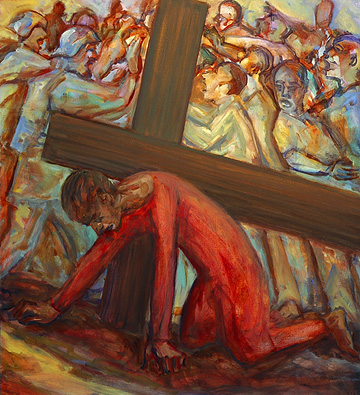
Jesus Falls for the Second Time
See the complete set of paintings at Church's "Anti-War" Paintings Draw Fire
"In his fatherly care for all of us, God desired that all men should form one family and deal with each other in a spirit of brotherhood. All, in fart, are destined to the very same end, namely God himself, since they have been created in the likeness of God who 'made from one every nation of men who live on all the face of the earth' (Acts 17:26). Love of God and of one's neighbor, then is the first and greatest commandment. Scripture teaches us that love of God cannot be separated from love of one's neighbor." Gaudium et Spes, 24.
The co-author of the most in-depth analysis what went wrong in the war in Iraq, Michael Gordon of the New York Times, who wrote "Cobra II" with General Bernard Trainor, said in an interview on Democracy Now!: "I think most of the U.S. military commanders there thought that there was a chance to put Iraq on a better course had we done some things differently, had we had more troops, had we had effective nation-building policies, had we not disbanded the army." True as such statements are, they also redirect our attention toward issues of technical competence rather than the larger one of how we treat those created in the image of God.
Further in the interview:
"AMY GOODMAN: General Trainor, you talk about the troika -- President Bush, Vice President Cheney and Rumsfeld -- making the decisions?
GEN. BERNARD TRAINOR: That's correct.That's a correct -- the three of them were joined at the hip, if I can use that expression. They all thought basically the same way, and their perceptions became reality. I think the President, I would describe it as the man who presided over the troika. I think Vice President Cheney was very influential in terms of the policy. And certainly, Secretary of Defense Rumsfeld was a man in charge of the execution of the policy. Everybody else was what I would describe as in the outer circle."
It appears that the corporate-controlled media has finally realized that there may be something amiss in Iraq. It also appears that this intractable fact is being framed so as to focus our attention away from the glaring violation of human dignity and the obligations we owe our brothers and sisters in Iraq. Actually, it seems to me that Gordon’s presentation ably frames the message of the day that the war was a fundamentally sound decision that became subverted through technical misjudgment. Notice how he moves the focus from the macro decision – to go to war – about which he pretends to be disinterested, to the micro decisions – to disband the army, to add more troops,etc.. The American media sees its job as focusing on the style and technique that is used to carry out decisions, not to question those decisions, or even allude to issues of substance. It is not a question of obtuseness – Mr. Gordon is surely aware of the larger issue – it’s a question of semantic strategy. By admitting infractions of the technical requirements for an effective invasion strategy, he fixes our attention on procedure, while the unspoken issue is “How do we effectively impose our system on other peoples?" about which experts may debate the best means to accomplish. The "troika" representation of Bush, Cheney, and Rumsfeld hints at a characterization of them as psychologically aberrant in contrast to the technical competence of the generals on the ground. The subtext is that we need to adjust our procedures if we want to be an effective empire. I’m afraid that far from the deliberate obtuseness that much of mainstream reporting seems to evince, it is guided by a political strategy that seeks to keep our attention focused on issues of technical competence and personality, while leaving the great sleeping giant of moral judgment fast asleep.
Friday, March 03, 2006
Who Are We?
"Every generation or so an evil arises which is so monstrous, so degrading to the human spirit, so morally bankrupt that even to debate it is a sign of moral corruption. Native American genocide, slavery, totalitarianism, and Jim Crow laws are evils so unspeakable that we cannot understand today how anyone with a shred of decency could have once supported them. Today, torture, a practice far more degrading to us than to our victims, represents such an evil...Bush's demand is unprecedented. No leader in all human history, not even Hitler, Stalin, or Mao, has publicly demanded the right to torture. All others have behaved as Bush did before the amendment when he secretly tortured on a scale unseen in American history even while saying he wasn't. Forced into the open by the McCain amendment, however, Bush chose to openly demand the legal right to torture. Most experts assume he will continue to torture...Mr. Bush's statement that "we do not torture," even as he was threatening to veto the entire Defense bill because it limited his right to torture, is a dramatic example of how torture degrades the torturer even more than it does his victims. And it is a disgraceful commentary on our nation that no major church, business, or political leader, nor the fawning media personalities who interview him and his officials, has expressed outrage at this bald-faced lie. And one can barely mention an unspeakable Congress, which ignored his lying about torture after spending two years impeaching his predecessor for lying about sex...The real question for us, however, is what this says not about President Bush and our other leaders, but about ourselves. What are we, as citizens, as human beings, willing to live with? Are we willing to live with a President, Vice-President, Secretary of Defense, Secretary of State, and Attorney-General who either engage in or rationalize torture in our names, even as they shamelessly deny they are doing so?" Fred Branfman, truthout, March 3, 2006.
The degradation that Fred is speaking of here is what we apply to the image of God when we fail to respect the image that lives within ourselves. As Jurgen Moltmann has so incisively expressed it, our likeness to God does not lie in our qualities. This would imply that the degree of our reason or our compassion would make us more or less similar to God and thereby determine our ontological status. The logic of this quickly leads to setting a few human beings in the category of "truly human" while the vast majority waste away in the outer darkness of inhumanity, to which we have relegated most of the population of the Middle East.
Our likeness to God embraces the whole family of this earth. Rather than trying to be like God in qualities, it is in our relationships that we attain true likeness, "Human beings' objective likeness to God subsists in God's relation to them. This is indestructable and can never be lost. Only God can end it. The dignity of each and every person is based on this objective likeness to God. God has a relationship to every embryo, every severely handicapped person, and every person suffeering from one of the diseases of old age, and he is honoured and glorified in them when their dignity is respected. Without the fear of God God's image will not be repected in every human being and the reverence for life will be lost, pushed out by utilitarian criteria. But in the fear of God there is no life that is worthless and unfit to live." Moltmann, God for a Secular Society, p. 84.
May we also add that our brothers and sisters in Iraq are crying out to us today to save them from a brutal and suicidal assault currently undertaken by American troops. Will you speak out or will you be one of those who said, "I didn't know that the Jews were being killed?"
The degradation that Fred is speaking of here is what we apply to the image of God when we fail to respect the image that lives within ourselves. As Jurgen Moltmann has so incisively expressed it, our likeness to God does not lie in our qualities. This would imply that the degree of our reason or our compassion would make us more or less similar to God and thereby determine our ontological status. The logic of this quickly leads to setting a few human beings in the category of "truly human" while the vast majority waste away in the outer darkness of inhumanity, to which we have relegated most of the population of the Middle East.
Our likeness to God embraces the whole family of this earth. Rather than trying to be like God in qualities, it is in our relationships that we attain true likeness, "Human beings' objective likeness to God subsists in God's relation to them. This is indestructable and can never be lost. Only God can end it. The dignity of each and every person is based on this objective likeness to God. God has a relationship to every embryo, every severely handicapped person, and every person suffeering from one of the diseases of old age, and he is honoured and glorified in them when their dignity is respected. Without the fear of God God's image will not be repected in every human being and the reverence for life will be lost, pushed out by utilitarian criteria. But in the fear of God there is no life that is worthless and unfit to live." Moltmann, God for a Secular Society, p. 84.
May we also add that our brothers and sisters in Iraq are crying out to us today to save them from a brutal and suicidal assault currently undertaken by American troops. Will you speak out or will you be one of those who said, "I didn't know that the Jews were being killed?"
The Death of Moral Imagination
"The Iraq War is a pure war, a war for the sake of war. Congress is debating whether to spend another fortune on it, another fortune that could completely remake this nation if spent on useful projects, and Congress has no reason for the war. The reason is purely that the media won't like you if you vote against a war, but there's no actual reason for the war - not the weapons of mass destruction that Bush always knew weren't there, not the ties to 9-11 that Bush always knew did not exist on behalf of a ruler who, anyway, is no longer in power, not reducing terrorism which has been increased by this war, not improving global relations when this war has driven global opinion of the US to a record low, not preventing a civil war which the US attack and occupation have created, not supporting the troops when most of the troops want to come home - and almost half of them openly admit to pollsters that they don't know why they're there." - David Swanson, Iraq: Pure War, Pure Crime, truthout, March 3, 2006.
Those of us who have watched the sickness grow for most of our lives know that its roots lie far deeper than fear of the media, those puppets of power. Still, we need to repeat the phrase until it takes root in the healthy soil of our defiance - this is a war without a reason. The Fathers of the Church often saw the essence of evil in its emptiness, the howling void in which it pretends to see its triumph. They don't know why they are there, and we don't know why we are so silent and complacent. We seem unable to peer into the emptiness that lies at the heart of our defection.
Let us listen to the words of Jurgen Moltman and laugh at the absurdity of evil, "Non-resistance to evil shows up the absurdity of evil. Evil's strength is violence. Evil's weakness is its wrongness. Counter-violence supplies evil with its supposed justification, and often enough stabilizes it. It is only the non-violent reaction which robs evil of every legitimation and puts the perpetrator of violence in the wrong, 'heaping burning coals on his head' (Rom. 12:20)." Jurgen Moltman, The Way of Jesus Christ. This is the love that will ultimately defeat evil, not by killing the evildoers, not by taking on their slavery ourselves, but by destroying the sin which has made all of us slaves.
William Sloan Coffin has provided a sound diagnosis: "People in every generation have striven for power, the only difference being that ours has achieved it. This is 'the century of total war' because this is the 'the age of omnipotence.' What has happened is curious. You know the expression 'A man's reach should exceed his grasp.' That means our moral imagination should stretch beyond what we are able to do. Now the situation is reversed: what we are able to do is beyond the reach of our moral imagination. Our capacity to destroy is virtually unlimited. But our capacity to imagine, to feel, to respond, is, as always, limited. Thus we are able to do physically what we cannot grasp morally. We are living beyond our moral means. This is the heart of our problem."
To flee our own emptiness we have created a war to cling to. We have voluntarily surrendered our rights because we did not have the moral capacity to grasp the duties of our freedom. Let us embrace our emptiness and ask for forgiveness.
Those of us who have watched the sickness grow for most of our lives know that its roots lie far deeper than fear of the media, those puppets of power. Still, we need to repeat the phrase until it takes root in the healthy soil of our defiance - this is a war without a reason. The Fathers of the Church often saw the essence of evil in its emptiness, the howling void in which it pretends to see its triumph. They don't know why they are there, and we don't know why we are so silent and complacent. We seem unable to peer into the emptiness that lies at the heart of our defection.
Let us listen to the words of Jurgen Moltman and laugh at the absurdity of evil, "Non-resistance to evil shows up the absurdity of evil. Evil's strength is violence. Evil's weakness is its wrongness. Counter-violence supplies evil with its supposed justification, and often enough stabilizes it. It is only the non-violent reaction which robs evil of every legitimation and puts the perpetrator of violence in the wrong, 'heaping burning coals on his head' (Rom. 12:20)." Jurgen Moltman, The Way of Jesus Christ. This is the love that will ultimately defeat evil, not by killing the evildoers, not by taking on their slavery ourselves, but by destroying the sin which has made all of us slaves.
William Sloan Coffin has provided a sound diagnosis: "People in every generation have striven for power, the only difference being that ours has achieved it. This is 'the century of total war' because this is the 'the age of omnipotence.' What has happened is curious. You know the expression 'A man's reach should exceed his grasp.' That means our moral imagination should stretch beyond what we are able to do. Now the situation is reversed: what we are able to do is beyond the reach of our moral imagination. Our capacity to destroy is virtually unlimited. But our capacity to imagine, to feel, to respond, is, as always, limited. Thus we are able to do physically what we cannot grasp morally. We are living beyond our moral means. This is the heart of our problem."
To flee our own emptiness we have created a war to cling to. We have voluntarily surrendered our rights because we did not have the moral capacity to grasp the duties of our freedom. Let us embrace our emptiness and ask for forgiveness.
Subscribe to:
Posts (Atom)
