In a recent article by Andrew Greeley, the causes of the war in Iraq are traced to U.S. political theater, "The real reasons for the war are too harsh to be fully accepted. The vice president wanted to tighten up on civil liberties. The secretary of defense wanted to wage a new kind of war. The neoconservative memo writers wanted to take pressure off of Israel. 'Our president' wanted to reap the glory of being a wartime president. The majority of Congress wanted to be seen as patriotic Americans. Many, perhaps most, Americans wanted revenge for the World Trade Center attack. Many, perhaps most, Americans believed that the war in Iraq was part of the 'war on terrorism.' -
Andrew Greeley, Evil of war brings unending pain, Chicago Sun-Times, March 10, 2006.
In this article, I would like to plunge more deeply into the crooked will that so regularly drives us into carnage. When we look at ourselves, we see the good intentions with which we are motivated and the ingratitude and spite with which our intentions are misunderstood and cast back at us. Whereas we are rational and compassion inspires our every deed, those who oppose us are, by definition, irrational, motivated by unfathomable fanaticisms, slaves of the violence of their own imaginations. In the words of Lila Rajiva, "If we examine why it is we refuse rationality to terrorists who offer us nothing but reasons, it becomes evident that it is because we refuse to admit our own irrationality. It is because we do not need or want reasons. The reasons we offer grow, metamorphose, vanish, but our will to violence remains. The provocation does not arise from our victim, for when he meets our demand, we remain insatiable. Our victim is irrelevant to a violence that merely finds an object in him." Lila Rajiva, The Language of Empire. Indeed, our will to violence remains in Iraq. We need to ask ourselves in all honesty, why do we stay? Reasons gather and scatter like leaves in the autumn wind, new ones rising up with every shift in the stellar alignments, yet the treasure we spend (and what treasure do we hold higher?) argues persuasively that we value this project above any cure for world hunger or end to the plagues that rot the lives languishing in the Third World or even the economic survival of our own people. What inspires us to this liberating deed?
"The torture at Abu Ghraib, like the bombing of Iraq, moves toward such limitless rationality that it becomes completely irrational, gratuitous, and without any purpose beside the display of power...This diminishment of the victim to an object rather than the acts themselves is what makes the torture and terror of the warfare state ultimately pornographic, for while the theater of the terrorist-insurgent seeks to communicate and is to that extent rational, our theater appears to be only a perverse enjoyment, a tasting of our freedom from all constraint, the self-pleasuring of power delighting in its own performance." The Language of Empire. This taste lingers in our mouths as the "revised" Patriot Act is passed by an overwhelming majority in Congress. We have grown impatient of the constraints and duties of a free people, based on never-ending and painstaking self examination. Conscience is an onerous task, and respecting the rights of others has become tasteless and insipid to palates thirsting for lustier refreshment. “Reason and respect/ Make livers pale and lustihood deject.”
“The conclusion is inescapable. The terror that is held up to us like a red rag is actually of our own making and allows each objective when reached to immediately recede, leaving an insatiable void into which we thrust with greater and greater violence, inflamed by weakness in a theater almost of sadism.” The Language of Empire. The violence we engage in never succeeds in staunching the terror it was intended to suppress, and secretly we know it never will. Once violence is seen as the cure, we are committed to pouring ever renewed doses of it into a situation that grows more hopeless with every dose. Tragically, history shows that this violence continues to grow until the emptiness of the false drama becomes insupportable and new dramas take the place of the myth of redemptive violence.
These dramas are not merely collective fantasies made real, but perform a specific task in the maintenance of power. They sustain the power of the terrorist state, “…torture makes real the power of the state on the body of the individual and on the body politic. Torture is a ‘liturgical’ enactment of the imaginative project of the state. Therefore the terrorist state is not just the agent of torture, but the effect of torture as well.” William Cavanaugh, Torture and Eucharist. Amnesty International has recently documented the continuing torture of detainees by U.S. and Iraqi forces (Complete report: http://web.amnesty.org/library/Index/ENGMDE140012006). Beyond the drama of redemption through blood purge, we also need to see our wills inscribed on the bodies of Arab victims. It doesn’t particularly matter which Arab victims, but we need to see the marks of our power. “As in wars between states, considerations of the motive and intents of the states are secondary to the effects on the object of intervention, whether it is the body on which the torture is inscribed or the population on which terror is rained…It is inequality in power, illegitimacy in its use, and disproportion in its application that constitute the essence of terrorism as it does torture. It is the humiliation and subjugation of whole populations through normalized physical and psychological violence and detention that constitutes terror or torture, especially in its most insidious form, the rational violence of the modern state to which we are blinded by language and ideology.” The Language of Empire. The aim, in every such intervention, is never to erase violence, to create a peaceful world, but to drive the violence “deep within the recesses of the individual”, Cavanaugh, ibid. Once the empire has left its mark on our victims, our lust is temporarily gorged.
As Christians, we must pray that this violence will be purged from our hearts. Rather than thrilling to the “shock and awe” of holy violence, let us keep the vision of John of Patmos before us where he speaks of one of the heads of the Beast: “One of its heads seemed to have received a death-blow, but its mortal wound had been healed. In amazement, the whole world followed the beast.” (Rev 13:3). In the words of Lee Griffith, “The Beast cannot be killed with violence. The mortal wound is healed. Like Hydra, the Beast is strengthened by all violent assaults.” Lee Griffiths, The War on Terrorism and the Terror of God.
Saturday, March 11, 2006


Thursday, March 09, 2006
One Family
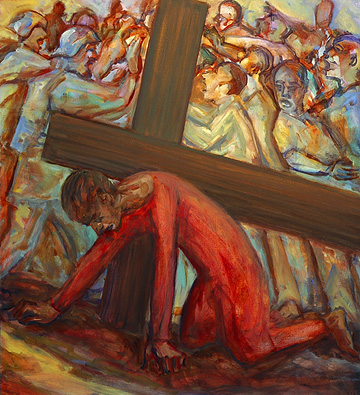
Jesus Falls for the Second Time
See the complete set of paintings at Church's "Anti-War" Paintings Draw Fire
"In his fatherly care for all of us, God desired that all men should form one family and deal with each other in a spirit of brotherhood. All, in fart, are destined to the very same end, namely God himself, since they have been created in the likeness of God who 'made from one every nation of men who live on all the face of the earth' (Acts 17:26). Love of God and of one's neighbor, then is the first and greatest commandment. Scripture teaches us that love of God cannot be separated from love of one's neighbor." Gaudium et Spes, 24.
The co-author of the most in-depth analysis what went wrong in the war in Iraq, Michael Gordon of the New York Times, who wrote "Cobra II" with General Bernard Trainor, said in an interview on Democracy Now!: "I think most of the U.S. military commanders there thought that there was a chance to put Iraq on a better course had we done some things differently, had we had more troops, had we had effective nation-building policies, had we not disbanded the army." True as such statements are, they also redirect our attention toward issues of technical competence rather than the larger one of how we treat those created in the image of God.
Further in the interview:
"AMY GOODMAN: General Trainor, you talk about the troika -- President Bush, Vice President Cheney and Rumsfeld -- making the decisions?
GEN. BERNARD TRAINOR: That's correct.That's a correct -- the three of them were joined at the hip, if I can use that expression. They all thought basically the same way, and their perceptions became reality. I think the President, I would describe it as the man who presided over the troika. I think Vice President Cheney was very influential in terms of the policy. And certainly, Secretary of Defense Rumsfeld was a man in charge of the execution of the policy. Everybody else was what I would describe as in the outer circle."
It appears that the corporate-controlled media has finally realized that there may be something amiss in Iraq. It also appears that this intractable fact is being framed so as to focus our attention away from the glaring violation of human dignity and the obligations we owe our brothers and sisters in Iraq. Actually, it seems to me that Gordon’s presentation ably frames the message of the day that the war was a fundamentally sound decision that became subverted through technical misjudgment. Notice how he moves the focus from the macro decision – to go to war – about which he pretends to be disinterested, to the micro decisions – to disband the army, to add more troops,etc.. The American media sees its job as focusing on the style and technique that is used to carry out decisions, not to question those decisions, or even allude to issues of substance. It is not a question of obtuseness – Mr. Gordon is surely aware of the larger issue – it’s a question of semantic strategy. By admitting infractions of the technical requirements for an effective invasion strategy, he fixes our attention on procedure, while the unspoken issue is “How do we effectively impose our system on other peoples?" about which experts may debate the best means to accomplish. The "troika" representation of Bush, Cheney, and Rumsfeld hints at a characterization of them as psychologically aberrant in contrast to the technical competence of the generals on the ground. The subtext is that we need to adjust our procedures if we want to be an effective empire. I’m afraid that far from the deliberate obtuseness that much of mainstream reporting seems to evince, it is guided by a political strategy that seeks to keep our attention focused on issues of technical competence and personality, while leaving the great sleeping giant of moral judgment fast asleep.
Friday, March 03, 2006
Who Are We?
"Every generation or so an evil arises which is so monstrous, so degrading to the human spirit, so morally bankrupt that even to debate it is a sign of moral corruption. Native American genocide, slavery, totalitarianism, and Jim Crow laws are evils so unspeakable that we cannot understand today how anyone with a shred of decency could have once supported them. Today, torture, a practice far more degrading to us than to our victims, represents such an evil...Bush's demand is unprecedented. No leader in all human history, not even Hitler, Stalin, or Mao, has publicly demanded the right to torture. All others have behaved as Bush did before the amendment when he secretly tortured on a scale unseen in American history even while saying he wasn't. Forced into the open by the McCain amendment, however, Bush chose to openly demand the legal right to torture. Most experts assume he will continue to torture...Mr. Bush's statement that "we do not torture," even as he was threatening to veto the entire Defense bill because it limited his right to torture, is a dramatic example of how torture degrades the torturer even more than it does his victims. And it is a disgraceful commentary on our nation that no major church, business, or political leader, nor the fawning media personalities who interview him and his officials, has expressed outrage at this bald-faced lie. And one can barely mention an unspeakable Congress, which ignored his lying about torture after spending two years impeaching his predecessor for lying about sex...The real question for us, however, is what this says not about President Bush and our other leaders, but about ourselves. What are we, as citizens, as human beings, willing to live with? Are we willing to live with a President, Vice-President, Secretary of Defense, Secretary of State, and Attorney-General who either engage in or rationalize torture in our names, even as they shamelessly deny they are doing so?" Fred Branfman, truthout, March 3, 2006.
The degradation that Fred is speaking of here is what we apply to the image of God when we fail to respect the image that lives within ourselves. As Jurgen Moltmann has so incisively expressed it, our likeness to God does not lie in our qualities. This would imply that the degree of our reason or our compassion would make us more or less similar to God and thereby determine our ontological status. The logic of this quickly leads to setting a few human beings in the category of "truly human" while the vast majority waste away in the outer darkness of inhumanity, to which we have relegated most of the population of the Middle East.
Our likeness to God embraces the whole family of this earth. Rather than trying to be like God in qualities, it is in our relationships that we attain true likeness, "Human beings' objective likeness to God subsists in God's relation to them. This is indestructable and can never be lost. Only God can end it. The dignity of each and every person is based on this objective likeness to God. God has a relationship to every embryo, every severely handicapped person, and every person suffeering from one of the diseases of old age, and he is honoured and glorified in them when their dignity is respected. Without the fear of God God's image will not be repected in every human being and the reverence for life will be lost, pushed out by utilitarian criteria. But in the fear of God there is no life that is worthless and unfit to live." Moltmann, God for a Secular Society, p. 84.
May we also add that our brothers and sisters in Iraq are crying out to us today to save them from a brutal and suicidal assault currently undertaken by American troops. Will you speak out or will you be one of those who said, "I didn't know that the Jews were being killed?"
The degradation that Fred is speaking of here is what we apply to the image of God when we fail to respect the image that lives within ourselves. As Jurgen Moltmann has so incisively expressed it, our likeness to God does not lie in our qualities. This would imply that the degree of our reason or our compassion would make us more or less similar to God and thereby determine our ontological status. The logic of this quickly leads to setting a few human beings in the category of "truly human" while the vast majority waste away in the outer darkness of inhumanity, to which we have relegated most of the population of the Middle East.
Our likeness to God embraces the whole family of this earth. Rather than trying to be like God in qualities, it is in our relationships that we attain true likeness, "Human beings' objective likeness to God subsists in God's relation to them. This is indestructable and can never be lost. Only God can end it. The dignity of each and every person is based on this objective likeness to God. God has a relationship to every embryo, every severely handicapped person, and every person suffeering from one of the diseases of old age, and he is honoured and glorified in them when their dignity is respected. Without the fear of God God's image will not be repected in every human being and the reverence for life will be lost, pushed out by utilitarian criteria. But in the fear of God there is no life that is worthless and unfit to live." Moltmann, God for a Secular Society, p. 84.
May we also add that our brothers and sisters in Iraq are crying out to us today to save them from a brutal and suicidal assault currently undertaken by American troops. Will you speak out or will you be one of those who said, "I didn't know that the Jews were being killed?"
The Death of Moral Imagination
"The Iraq War is a pure war, a war for the sake of war. Congress is debating whether to spend another fortune on it, another fortune that could completely remake this nation if spent on useful projects, and Congress has no reason for the war. The reason is purely that the media won't like you if you vote against a war, but there's no actual reason for the war - not the weapons of mass destruction that Bush always knew weren't there, not the ties to 9-11 that Bush always knew did not exist on behalf of a ruler who, anyway, is no longer in power, not reducing terrorism which has been increased by this war, not improving global relations when this war has driven global opinion of the US to a record low, not preventing a civil war which the US attack and occupation have created, not supporting the troops when most of the troops want to come home - and almost half of them openly admit to pollsters that they don't know why they're there." - David Swanson, Iraq: Pure War, Pure Crime, truthout, March 3, 2006.
Those of us who have watched the sickness grow for most of our lives know that its roots lie far deeper than fear of the media, those puppets of power. Still, we need to repeat the phrase until it takes root in the healthy soil of our defiance - this is a war without a reason. The Fathers of the Church often saw the essence of evil in its emptiness, the howling void in which it pretends to see its triumph. They don't know why they are there, and we don't know why we are so silent and complacent. We seem unable to peer into the emptiness that lies at the heart of our defection.
Let us listen to the words of Jurgen Moltman and laugh at the absurdity of evil, "Non-resistance to evil shows up the absurdity of evil. Evil's strength is violence. Evil's weakness is its wrongness. Counter-violence supplies evil with its supposed justification, and often enough stabilizes it. It is only the non-violent reaction which robs evil of every legitimation and puts the perpetrator of violence in the wrong, 'heaping burning coals on his head' (Rom. 12:20)." Jurgen Moltman, The Way of Jesus Christ. This is the love that will ultimately defeat evil, not by killing the evildoers, not by taking on their slavery ourselves, but by destroying the sin which has made all of us slaves.
William Sloan Coffin has provided a sound diagnosis: "People in every generation have striven for power, the only difference being that ours has achieved it. This is 'the century of total war' because this is the 'the age of omnipotence.' What has happened is curious. You know the expression 'A man's reach should exceed his grasp.' That means our moral imagination should stretch beyond what we are able to do. Now the situation is reversed: what we are able to do is beyond the reach of our moral imagination. Our capacity to destroy is virtually unlimited. But our capacity to imagine, to feel, to respond, is, as always, limited. Thus we are able to do physically what we cannot grasp morally. We are living beyond our moral means. This is the heart of our problem."
To flee our own emptiness we have created a war to cling to. We have voluntarily surrendered our rights because we did not have the moral capacity to grasp the duties of our freedom. Let us embrace our emptiness and ask for forgiveness.
Those of us who have watched the sickness grow for most of our lives know that its roots lie far deeper than fear of the media, those puppets of power. Still, we need to repeat the phrase until it takes root in the healthy soil of our defiance - this is a war without a reason. The Fathers of the Church often saw the essence of evil in its emptiness, the howling void in which it pretends to see its triumph. They don't know why they are there, and we don't know why we are so silent and complacent. We seem unable to peer into the emptiness that lies at the heart of our defection.
Let us listen to the words of Jurgen Moltman and laugh at the absurdity of evil, "Non-resistance to evil shows up the absurdity of evil. Evil's strength is violence. Evil's weakness is its wrongness. Counter-violence supplies evil with its supposed justification, and often enough stabilizes it. It is only the non-violent reaction which robs evil of every legitimation and puts the perpetrator of violence in the wrong, 'heaping burning coals on his head' (Rom. 12:20)." Jurgen Moltman, The Way of Jesus Christ. This is the love that will ultimately defeat evil, not by killing the evildoers, not by taking on their slavery ourselves, but by destroying the sin which has made all of us slaves.
William Sloan Coffin has provided a sound diagnosis: "People in every generation have striven for power, the only difference being that ours has achieved it. This is 'the century of total war' because this is the 'the age of omnipotence.' What has happened is curious. You know the expression 'A man's reach should exceed his grasp.' That means our moral imagination should stretch beyond what we are able to do. Now the situation is reversed: what we are able to do is beyond the reach of our moral imagination. Our capacity to destroy is virtually unlimited. But our capacity to imagine, to feel, to respond, is, as always, limited. Thus we are able to do physically what we cannot grasp morally. We are living beyond our moral means. This is the heart of our problem."
To flee our own emptiness we have created a war to cling to. We have voluntarily surrendered our rights because we did not have the moral capacity to grasp the duties of our freedom. Let us embrace our emptiness and ask for forgiveness.
Friday, February 24, 2006
Force Drift
The Christian does not look first at the shining image of his own salvation, the national myth that feeds his secret self-sufficiency, dancing in the mirror of the delightful burden of liberating others from their unlikeness to himself. Yet this is what we hear from thoughtless pulpits that sink our hearts in a shallow sea of faithless consolation. When will we turn the mirror on ourselves and feel the illusions which our violence needs, or, in the words of Lila Rajiva, "When the villainy is ours but the fault lies at higher levels of the state, the language ceases to form a personal narrative and disaggregates into the shapeless jargon bureaucracy, shifting attention away from the actors to the process, diffusing their responsibility like pixels on a screen." Lila Rajiva, "The Language of Empire", New York, Monthly Review Press, 2005, p. 84.
"Mora—along with the Naval Criminal Investigative Service’s Chief Psychologist Dr. Michael Gelles, who was stationed at Guantanamo—warned in this memo that 'once the initial barrier against the use of force had been breached, a phenomenon know as ‘force drift' would almost certainly begin… [and] if left unchecked, force levels, to include torture, could be reached.' Mora was ultimately unsuccessful in his efforts to persuade Haynes and Rumsfeld to reverse the policy of abusive interrogation—and we now know that he was right to be concerned about 'force drift.'" - New Photos: Why Now? TomPaine.com, Feb. 23, 2006.
The initial barrier has been breached. It was the boundary that separated fantasy torture from real degradation, and we have crossed it. Either by the bureaucratic jargon that redefines the most serious psychic wounds a human being can suffer as collateral damage, or the silence that refuses to trouble itself about human beings in pain but outside its immediate reach, we have crossed into the land of perpetual twilight. God forgive us, but I fear that the wounds we now ignore may soon become our own.
"Mora—along with the Naval Criminal Investigative Service’s Chief Psychologist Dr. Michael Gelles, who was stationed at Guantanamo—warned in this memo that 'once the initial barrier against the use of force had been breached, a phenomenon know as ‘force drift' would almost certainly begin… [and] if left unchecked, force levels, to include torture, could be reached.' Mora was ultimately unsuccessful in his efforts to persuade Haynes and Rumsfeld to reverse the policy of abusive interrogation—and we now know that he was right to be concerned about 'force drift.'" - New Photos: Why Now? TomPaine.com, Feb. 23, 2006.
The initial barrier has been breached. It was the boundary that separated fantasy torture from real degradation, and we have crossed it. Either by the bureaucratic jargon that redefines the most serious psychic wounds a human being can suffer as collateral damage, or the silence that refuses to trouble itself about human beings in pain but outside its immediate reach, we have crossed into the land of perpetual twilight. God forgive us, but I fear that the wounds we now ignore may soon become our own.
Saturday, February 18, 2006
Shut It Down
"People in every generation have striven for power, the only difference begin that ours has achieved it. This is 'the century of total war' because this is 'the age of omnipotence.' What has happened is curious. You know the expression 'A man's reach should exceed his grasp.' That means our moral imagination should stretch beyond what we are able to do. Now the situation is reversed: what we are able to do is beyond the reach of our moal imagination. Our capacity to destroy is virtually unlimited. But our capacity to imagine, to feel, to respond, is, as always, limited. Thus we are able to do physically what we cannot grasp morally. We are living beyond our moral means. That is the heart of our problem." - William Sloan Coffin.
Any Christian who cares to know knows that people are being tortured at Guantanamo as we speak. '[A high court judge in England] said: "America's idea of what is torture is not the same as ours and does not appear to coincide with that of most civilised nations.' He made his comments, he said, after learning of the UN report that said Guantánamo should be shut down without delay because torture was still being carried out there.
The report, by five inspectors for the UN human rights commissioner, refers to shackling, hooding and forcing detainees to wear earphones and goggles. In particular, it refers to interrogation techniques and excessive violence used to forcefeed prisoners on hunger strike. Based on interviews with detainees' lawyers, former inmates and written exchanges with US officials, it calls on the US to put the 490 inmates on trial or release them."
Torture is but the failure of imagination unleashed by our sense of omnipotence. In the words of Alfred McCoy, "As past perpetrators could have told today's pundits, torture plumbs the recesses of human consciousness, unleashing an unfathomable capacity for cruelty as well as seductive illusions of potency."
"The CIA's psychological torture paradigm used two new methods, sensory disorientation and 'self-inflicted pain,' both of which were aimed at causing victims to feel responsible for their own suffering and so to capitulate more readily to their torturers...Although seemingly less brutal than physical methods, the CIA's 'no touch' torture actually leaves deep, searing psychological scars on both victims and -- something seldom noted -- their interrogators. Victims often need long treatment to recover from a trauma many experts consider more crippling than physical pain. Perpetrators can suffer a dangerous expansion of ego, leading to escalating acts of cruelty and lasting emotional disorders. When applied in actual operations, the CIA's psychological procedures have frequently led to unimaginable cruelties, physical and sexual, by individual perpetrators whose improvisations are often horrific and only occasionally effective." - Alfred McCoy, http://www.tomdispatch.com/index.mhtml?emx=x&pid=1795.
Will you join me in praying for these victims of our silence and passivity, and, should I add, the common "Christian" focus on our own psychological contests rather than on the suffering of those who pay the price for our comfort and security?
Any Christian who cares to know knows that people are being tortured at Guantanamo as we speak. '[A high court judge in England] said: "America's idea of what is torture is not the same as ours and does not appear to coincide with that of most civilised nations.' He made his comments, he said, after learning of the UN report that said Guantánamo should be shut down without delay because torture was still being carried out there.
The report, by five inspectors for the UN human rights commissioner, refers to shackling, hooding and forcing detainees to wear earphones and goggles. In particular, it refers to interrogation techniques and excessive violence used to forcefeed prisoners on hunger strike. Based on interviews with detainees' lawyers, former inmates and written exchanges with US officials, it calls on the US to put the 490 inmates on trial or release them."
Torture is but the failure of imagination unleashed by our sense of omnipotence. In the words of Alfred McCoy, "As past perpetrators could have told today's pundits, torture plumbs the recesses of human consciousness, unleashing an unfathomable capacity for cruelty as well as seductive illusions of potency."
"The CIA's psychological torture paradigm used two new methods, sensory disorientation and 'self-inflicted pain,' both of which were aimed at causing victims to feel responsible for their own suffering and so to capitulate more readily to their torturers...Although seemingly less brutal than physical methods, the CIA's 'no touch' torture actually leaves deep, searing psychological scars on both victims and -- something seldom noted -- their interrogators. Victims often need long treatment to recover from a trauma many experts consider more crippling than physical pain. Perpetrators can suffer a dangerous expansion of ego, leading to escalating acts of cruelty and lasting emotional disorders. When applied in actual operations, the CIA's psychological procedures have frequently led to unimaginable cruelties, physical and sexual, by individual perpetrators whose improvisations are often horrific and only occasionally effective." - Alfred McCoy, http://www.tomdispatch.com/index.mhtml?emx=x&pid=1795.
Will you join me in praying for these victims of our silence and passivity, and, should I add, the common "Christian" focus on our own psychological contests rather than on the suffering of those who pay the price for our comfort and security?
Wednesday, February 15, 2006
Resist the Beginnings
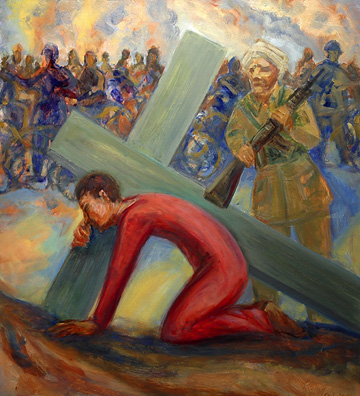
Jesus Falls for the First Time
See the complete set of paintings at Church's "Anti-War" Paintings Draw Fire
Larry Rassmussen distills the lessons learned (and since forgotten?) by Dietrich Bonhoeffer in the 1930's:
"Moral-spiritual formation, with its powers of discernment, was a needed habit of life before crises arose so that fascism could be sharply challenged before it became entrenched. 'Resist the beginnings' is the requirement. Resist the beginnings of compromises that dull the moral senses and take their ease in a life of cheap grace. Resist the beginnings that give evil, willed blindness, and civic passivity a foothold. Don’t let the right eye wink at complicity or the left hand abet it. Resist becoming unwitting accomplices to an errant leader. Resist all the places in your own soul that give way. A discerning spirituality is as vital as the right politics and indispensable to it." - Larry Rasmussen, The Steep Price of Grace, Sojourners, February 2006.
As Bonhoeffer said it so well, "Cheap grace is not the kind of forgiveness of sins which frees us from the toils of sin. Cheap grace is the grace we bestow on ourselves." - The Cost of Discipleship.
Resist the beginnings. Resist the beginnings of the call to surrender, to be ordinary, to live 'unpretentiously', without 'arrogance', or bringing attention to ourselves. In fact we are called to incarnate, not to pretend, to incarnate peace while violence rages in our unpretentiousness.
Many were meek before us: "Religious leadership, too, was largely conservative. Many Protestant clergy shared the nationalism of the Nazis, their disdain for the 'loose morals' of the ’20s, and their hostility to the liberal-secular state. Hitler in turn deftly employed God-talk to describe Germany’s calling and destiny. In his very first radio address he declared that 'the National Government would preserve and defend those basic principles on which the nation has been built.' These principles, he said, 'regard Christianity as the foundation of our national morality and the family as the basis of national life.' 'Positive Christianity” was the tag-phrase the party used for its platform and 'Kinder, Küche, Kirche' ('Children, Kitchen, Church') became something of a mantra."
Perhaps it is only the incompetence of our current Fox-Hitlers that buffers us from Bonhoeffer's fate. "American Christianity" has laid the foundation of a mystical revival, but, as yet, we are still uncatalyzed and survive in the stew of tepid democracy which nonetheless we daily make ourselves less worthy of. But how long can we depend on this incompetence?
"In early 1933, a movement in the Protestant churches, dubbing itself the 'German Christians,' rallied in support of the Nazi Party’s call for Aryan Christianity and the consolidation of the provincial churches into a single state-coordinated 'Reich Church' headed by a 'Reich Bishop.' The aggressive, anti-Semitic nationalism of these German Christians, their deference to Hitler as the rescuer of a humiliated Germany, and their support of the party’s platform alarmed other Protestants. Numerous Christians of Jewish heritage were in the Protestant church, and 37 of them were pastors. The state declared all of them 'full Jews' and began stripping them of their civil rights and liberties. This racist push for Aryan Christianity precipitated a counter movement, soon called the 'Confessing Church.' What would and could the churches do?" - Larry Rasmussen, The Steep Price of Grace, Sojourners, February 2006.
Will you keep awake and watch with me?
Sunday, February 12, 2006
An Open Ear
"It is consoling, of course, to view ourselves as models of rectitude and even more so as misunderstood models of rectitude. But simple honesty compels us to see that we are as other nations are. The trouble with saying 'The only thing that the other side understands is force' is that you have to behave as if the only thing you understand is force." - William Sloan Coffin.
The behavior of the armed forces in Iraq is a case in point. Would that the fierce faith we place in smart bombs could be given to the Lord of Life.
Believe it or not, Nonviolent Jesus has been around for nearly two years. I would like to pause in the unremitting weekly posts and hear a word or two of feedback. I know that there are several regular readers. This time I would like to hear from you if you find the service helpful and particularly, what other types of information you might find helpful in our common struggle against war.
The behavior of the armed forces in Iraq is a case in point. Would that the fierce faith we place in smart bombs could be given to the Lord of Life.
Believe it or not, Nonviolent Jesus has been around for nearly two years. I would like to pause in the unremitting weekly posts and hear a word or two of feedback. I know that there are several regular readers. This time I would like to hear from you if you find the service helpful and particularly, what other types of information you might find helpful in our common struggle against war.
Saturday, February 04, 2006
Call to Courage
Cure thy children's warring madness,
Bend our pride to thy control;
Shame our wanton selfish gladness
Rich in things and poor in soul.
- Harry Emerson Fosdick
"Peace always seems a weary way off. As Jeremiah lamented, 'We looked for peace, but no peace came.' But to give up on peace is to give up on God." - William Sloan Coffin.
Daniel Ellsberg: "I would not have thought of copying the Pentagon Papers, risking a possible lifetime in prison, without the example of thousands of young Americans who were doing everything they could--including non-violent disobedience to the draft regulations--to oppose a wrongful, hopeless war. They showed civic courage, and I can attest to its effectiveness; as a government consultant and former official, I felt its power on my own life.
In the face of a president blatantly violating the law, pursuing another stalemated, hopeless, wrongful war, and proclaiming his intent to continue both, civic courage is needed today from those who can hold him and his administration to account: members of Congress, journalists, potential whistleblowers inside the government, prosecutors and judges. "Everything they can do," even at cost to their positions and careers, is what is needed from those in such strategic positions at this moment, and what we should demand of them, by our own example. Nothing less is appropriate to this constitutional crisis.
Courage is contagious. One way members of the public can awaken courageous initiatives by such people is by confronting them with the spectacle of masses of plain citizens showing their faces together in public streets and squares to express their outrage, their condemnation and rejection of official practices. Demonstrations scheduled for this Saturday in Washington, D.C. can, among other things, encourage Congressional representatives to use their full powers in upcoming investigations to expose and curtail governmental abuses --starting on Monday in the Senate Judiciary Committee on the blatantly illegal and unconstitutional domestic spying by the administration."
Please consider participating in the demonstration on Feb. 4. At this point, only determined opposition from American citizens can stop the consolidation of power by those who would establish a corporatist state in America. This is a cry for hope. In the end, despite the seeming technological inevitability of the corporatist takeover, it is human beings who are carrying out this power grab. Human beings with an inextinguishable capacity for conscience, not the bloodless masks of corruption that their behavior demonstrates so convincingly. Their conversion will free them from their capacity for destruction. In the words of Jon Sobrino, "We must free him from this evil, and this is what forgiveness tries to do: convert and re-create the sinner." Pray for their conversion and our own conversion from an equally sinful silence. Pray too that those in positions of power in the U.S. government may show their conversion by acts of openess and honesty. Many will have to pay the price exacted by the vengefulness of those who mask their addiction to power behind Christian rhetoric, but eventually they will be unable to suppress a multitude of voices. Let these voices sound out.
Bend our pride to thy control;
Shame our wanton selfish gladness
Rich in things and poor in soul.
- Harry Emerson Fosdick
"Peace always seems a weary way off. As Jeremiah lamented, 'We looked for peace, but no peace came.' But to give up on peace is to give up on God." - William Sloan Coffin.
Daniel Ellsberg: "I would not have thought of copying the Pentagon Papers, risking a possible lifetime in prison, without the example of thousands of young Americans who were doing everything they could--including non-violent disobedience to the draft regulations--to oppose a wrongful, hopeless war. They showed civic courage, and I can attest to its effectiveness; as a government consultant and former official, I felt its power on my own life.
In the face of a president blatantly violating the law, pursuing another stalemated, hopeless, wrongful war, and proclaiming his intent to continue both, civic courage is needed today from those who can hold him and his administration to account: members of Congress, journalists, potential whistleblowers inside the government, prosecutors and judges. "Everything they can do," even at cost to their positions and careers, is what is needed from those in such strategic positions at this moment, and what we should demand of them, by our own example. Nothing less is appropriate to this constitutional crisis.
Courage is contagious. One way members of the public can awaken courageous initiatives by such people is by confronting them with the spectacle of masses of plain citizens showing their faces together in public streets and squares to express their outrage, their condemnation and rejection of official practices. Demonstrations scheduled for this Saturday in Washington, D.C. can, among other things, encourage Congressional representatives to use their full powers in upcoming investigations to expose and curtail governmental abuses --starting on Monday in the Senate Judiciary Committee on the blatantly illegal and unconstitutional domestic spying by the administration."
Please consider participating in the demonstration on Feb. 4. At this point, only determined opposition from American citizens can stop the consolidation of power by those who would establish a corporatist state in America. This is a cry for hope. In the end, despite the seeming technological inevitability of the corporatist takeover, it is human beings who are carrying out this power grab. Human beings with an inextinguishable capacity for conscience, not the bloodless masks of corruption that their behavior demonstrates so convincingly. Their conversion will free them from their capacity for destruction. In the words of Jon Sobrino, "We must free him from this evil, and this is what forgiveness tries to do: convert and re-create the sinner." Pray for their conversion and our own conversion from an equally sinful silence. Pray too that those in positions of power in the U.S. government may show their conversion by acts of openess and honesty. Many will have to pay the price exacted by the vengefulness of those who mask their addiction to power behind Christian rhetoric, but eventually they will be unable to suppress a multitude of voices. Let these voices sound out.
The First Followers of Jesus

Jesus is Placed in his Mother's Arms
See the complete set of paintings at Church's "Anti-War" Paintings Draw Fire
"'Those who oppress the poor insult their Maker' (Prov. 14:31). But the hard question is, how are the poor to be helped - by charity or by justice, by voluntary contribution or by legislation? In the book of Acts we read of the first Christian communities: 'There was not a needy person among them, for as many as were possessors of lands or houses sold them...and distribution was made to each as any had need.' Acts 2:44-45...Human nature is sinful, and therefore the virtue of the few will never compensate for the inertia of the many. Rich people and rich nations will not voluntarily open their eyes to see the biblical truth that the poor have ownership rights in their surplus. This they will see only in retrospect, after their surplus is taken away - by legislation, hopefully, not by violence. Given human goodness, voluntary contributions are possible, but given human sinfulness, legislation is indispensable. Charity, yes always; but never as a substitute for justice. What we keep forgetting in this country is that people have rights, basic rights: the right to food, the right to decent housing, the right to medical care, the right to education." - William Sloan Coffin. Since these goods are rights, it is fitting that they should be provided by government, whose job is not merely to execute criminals, but to defend the rights of those who have no other protection. This job cannot be carried out effectively by private individuals, but must be organized and systematic since it is a question of social duty, not individual impulse. To put the matter succinctly, "Charity is a matter of personal attributes; justice a matter of public policy. Charity seeks to alleviate the effects of injustice; justice seeks to eliminate the causes of it." This is what the fundamentalists have lost touch with - justice as a matter of society as a whole as embodied in government. If it's Old Testament dispensations you need, you might want to take a look at the words of Isaiah, whose conscience was stricken far more by social sin than individual sin.
Saturday, January 28, 2006
The Sacredness of Human Dignity
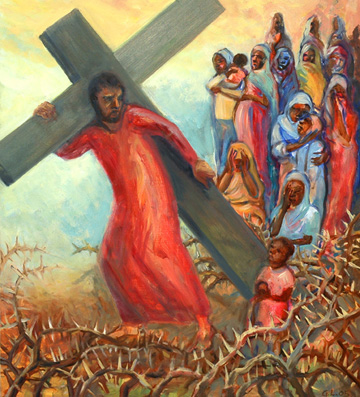
Jesus Speaks to the Weeping Women
See the complete set of paintings at Church's "Anti-War" Paintings Draw Fire
"We need to name torture for what it is -- sin," said Glen Stassen, professor of Christian ethics at the evangelical Fuller Theological Seminary. "It is the sin of usurping authority and making yourself the replacement for God, the sin of dominating the powerless, the sin of violating God's creation." National Religious Campaign Against Torture (NRCAT), Jan 13 - 15, Princeton, N.J.
For the first time in modern history, a government has demanded the right to openly and legally commit torture against those whom it deems terrorists. That government is the United States of America and its supposed "right to torture" must be opposed by everyone who considers him or herself a Christian. The following article in Christianity Today summarizes some of the main points: http://www.christianitytoday.com/ct/2006/002/23.32.html
1) Torture violates the dignity of the human being. I would argue more strongly than the author of this piece that human dignity requires an absolute ban on torture, that no interrogatory torture can ever be justified. Any intentional infliction of pain on another human being must be considered anathema to a Christian, the opposite of the Gospel.
2) Torture mistreats the vulnerable and violates the demands of justice.
3) Authorizing torture trusts government too much. The author is correct that we should not trust the government (or anyone else) with the right to torture, but I would go farther. The author seems to imply that some ideal agency may be trusted to torture, but that as fallen creatures, we cannot be permitted such dominion over other human beings. I would argue that no agency can ever be permitted to torture - that the act of doing is intrinsically corrupting and therefore impermissable.
4) Torture dehumanizes the torturer. Once again, the author portrays this as a matter of trust. In fact, if torture is inherently degrading, principally to the torturer, then the ban must be absolute.
5) Torture erodes the character of the nation that tortures. I certainly don't know that we are "better than our enemies" in the words of John McCain. The evidence seems rather strongly in the opposite direction. Yet, clearly, torture not only degrades the torturer, but the nation of "Christians" whose silence countenances it.
In sum, these arguments seem pragmatic rather than fundamental and based on derivative principles. But perhaps they can serve as the starting point for a more penetrating discussion.
Saturday, January 21, 2006
Maladjusted

Jesus Nailed to the Cross
See the complete set of paintings at Church's "Anti-War" Paintings Draw Fire
Part of my work as an antiwar activist has been to help returning soldiers cope with PTSD, Post Traumatic Stress Disorder, which will affect some 50,000 Iraq and Afghanistan veterans, according to predictions. Yet the more I contemplate this "personality disorder", the more I have come to believe that it is no "disorder" but rather the spirit's shriek of protest from a sanity that refuses to die. In the words of one who has lived within this agony of moral clarity, "Post-traumatic stress is not a disorder. Calling it that earns it a place in the DSM IV, professionalizes and medicalizes this very accurate perception that the world is not safe, and that life is not a comforting film convention. Calling it an individual 'disorder' cloaks the social systems responsible for experiences like Vietnam and Iraq." Stan Goff, "Returning Home Alive", trouthout, Jan. 20, 2006. He is refering to Douglas Barber, an Iraq veteran who blew his head off with a shotgun on Jan. 16, 2006, in the words of Goff, to "quiet the chaos in his head". Too many Christians have made their peace with this chaos, the deep chaos of believing in a nonviolent Jesus while the Douglas Barbers of the world suffer the chaos our silence has inflicted.
Stan Goff once again: "And it renders invisible the fact that Douglas Barber was not merely a suicide. Douglas Barber was nurtured on the illusions that secure our obedience, but when the real system needed to demonstrate to the rest of the world just how unsafe our nation could make them as the price of disobedience, the vile carnival barkers of the Bush administration, like administrations before them, did not recruit the children of Martha's Vineyard or Georgetown...They went, as they have always done, to places like Lee County, Alabama, where simple people have formed powerful affective attachments to the myth of our national moral superiority. When that world view, that architecture of meaning, collapses in the face of realities like convoy Russian roulette, and women holding babies up to prevent being shot, and daily stories of slaughter by the people one sleeps with, the profound betrayal of it is not experienced as some quiet, somber sadness. It is experienced like bees swarming out of a hive that has been broken, as a howling chaos. So we quiet it with marijuana, alcohol, heroin, and even shotguns."
The women holding up their babies to prevent Americans from slaughtering busloads of Iraqis attempting to go about what's left of their business refers to the following incident in Douglas' tour of duty in the War for Democracy, "When Doug was in a traffic jam one day, feeling very vulnerable, and the US units dismounted to clear the traffic jam - angry and afraid and waving weapons at the civilians - a woman in a bus held up her baby for them to see ... like that window-sign we see in cars on American highways, 'Baby on Board.' Only she wasn't cautioning other drivers to be careful. She was trying to prevent an armed attack that could kill her child."
What inner compromise prevents us from questioning the god of "Christians" who let babies be murdered so that we can safely rape the planet? Is the failure to be adjusted to this "Christian civilization" a psychological disease to be banished by numbing the inner scars of our warriors with drugs?
As Christians we should celebrate our maladjustment. "[The prophets] were maladjusted to the quiescence and obedience that passed for good social order, an order of mass impoverishment and copious bloodshed. They were abnormal in their refusal to join in the endless rounds of compromise of spirit and conscience. In short, as Abraham Heschel described it, the maladjustments and abnormalities that beset the prophets were actually a form of 'moral madness.'" Lee Griffith, "The War on Terrorism and the Terror of God, Grand Rapids, Mich.: Eerdmans, 2002, p. 116.
When the priests were about to kill Jeremiah, he spoke as follows, "Yahweh himself sent me to say all the things you have heard against this Temple and this city. So now amend your behavior and actions, listen to the voice of Yahweh your God...For myself, I am as you see in your hands. Do whatever you please or think right with me." Jeremiah 26: 12 - 13. Where are the Christians who refuse to believe that their faith is a therapy of adjustment to empire?
Sunday, January 15, 2006
The Father of Lies
"…Sacred Scripture, in its very first book, Genesis, points to the lie told at the very beginning of history by the animal with a forked tongue, whom the Evangelist John calls 'the father of lies' (Jn 8:44). Lying is also one of the sins spoken of in the final chapter of the last book of the Bible, Revelation, which bars liars from the heavenly Jerusalem: 'outside are... all who love falsehood' (22:15). Lying is linked to the tragedy of sin and its perverse consequences, which have had, and continue to have, devastating effects on the lives of individuals and nations. We need but think of the events of the past century, when aberrant ideological and political systems wilfully twisted the truth and brought about the exploitation and murder of an appalling number of men and women, wiping out entire families and communities. After experiences like these, how can we fail to be seriously concerned about lies in our own time, lies which are the framework for menacing scenarios of death in many parts of the world." Pope Benedict XVI, Message of Peace, Jan. 1, 2006.
Saturday, January 14, 2006
This is Your Freedom
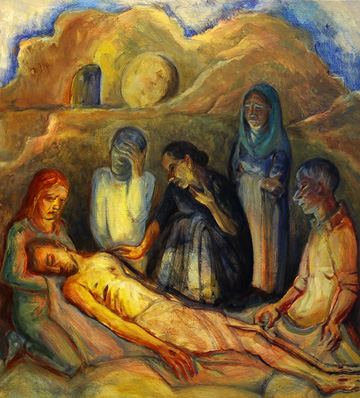
Jesus is Laid in the Tomb
See the complete set of paintings at Church's "Anti-War" Paintings Draw Fire
"In a May 7th (2004) dispatch reproduced by IBC, New Standard correspondent Dahr Jamail reported that “rows and rows of fresh graves” occupied by civilians killed by their American “liberators” “filled the football stadium in Fallujah. Many of [the graves],” Jamail noted, “are smaller than others. My translator Nermim reads the gravestones to me: ‘This one is a little girl.’ We take another step. ‘This is one is her sister.’ Next to them is their mother.”
“We walk,” Jamail continued, “slowly under the scorching sun along dusty rows of humble headstones. She continues reading aloud to me: ‘Old man wearing jacket with black dishasho, near industrial center. He has a key in his hand.’ Many of the bodies were buried before they could be identified. Tears are welling up in my eyes as she quickly reads: ‘Man wearing red track suit.’ She points to another row: ‘three women killed in car leaving city by American missile.’”
Jamail quoted an Iraqi man who “’saw American snipers shoot a woman while she was hanging her clothes’
“Another man” interviewed by Jamail pointed to a mosque and recalled that “Marines entered the mosque before they bombed it and slit the throats of refugees. This,” the man asked Jamail, “is their democracy? This is their freedom?’”
"One of the bodies brought to the [Falluja] clinic," wrote Jamail on April 14th, 2004, "was that of a 55-year old man shot in the back by a [U.S.] sniper outside his home, while his wife and children huddled wailing inside. The family could not retrieve his body for fear of being shot themselves. His stiff corpse was carried into the clinic, flies swarming above it. One of his arms was half raised by rigor mortis” (www.iraqbodycount.org/resources/falluja/index.php)" - "Thomas Friedman and the Murder of Civilians", Paul Street, ZNET, Jan. 5, 2006.
The resort to war is not written in stone. These crimes, and we are speaking specifically about violations of the Geneva Conventions which enshrine the principle that persons who do not take part in armed hostilities are entitled to specal protection and humane treatment, are the result of decisions by this administration that show no regard for the life of Iraqis. Our temptation as resisters of these crimes is to despair of the goodness inherent in both a corrupt and Godless administration and a public anesthetized to the point of inanity. For Americans in particular, it would seem, to act without, not just immediate success, but even the realistic prospect of success, violates the worship of success which our culture has long incarnated. As war resisters, the culture that uses war as a first resort and, with the fall of any economic alternative to "savage capitalism", encounters no rival on the world scene, seems beyond challenge as it more and more openly violates the moral principles regarding torture, war, and fundamental human rights. Domination of the media has led to a sense that the current world order is beyond question, that we are staring into the "end of history", in the memorable words of one neoconservative. As Christians, we must remember that it is not and never will be until Christ comes again.
As Christians, our primary duty is to the truth, which is also love. We must recognize that we are living in a country that has placed itself outside the laws of humanity. This is now officially recognized in Europe, "Dick Marty, the Swiss lawmaker leading the probe on behalf of the Council of Europe, said there was no question the CIA was undertaking illegal activities in Europe in its transportation and detention of terror suspects. 'The strategy in place today respects neither human rights nor the Geneva Conventions,' Marty said at a news conference in the Swiss town of Burgdorf. 'The current administration in Washington is trying to combat terrorism outside legal means, the rule of law.'" "Investigator believes CIA flouted law in Europe", AP, Jan. 14, 2006.
Once we recognize the beast in whose belly we live, our duty, as Christians, is to resist with whatever weapons God has granted us, to the limit of our strength, leaving all prospect of success in His all-caring hands. Success will come first in the form of a newly-formed heart.
Saturday, January 07, 2006
Incanting Anemic Souls into Heaven
An essay by Chuck Gutenson, which can be found here, punctures the smug assumptions of much neoconservative religiosity, which dutifully fulfills its role as "moral ballast", in the words of Wendell Berry, by "incanting anemic souls into heaven." In the piercing formulation of Budde and Brimlow's Christianity Incorporated, "Our primary assertion is this: to the extent that capitalist formation succeeds, Christian formation fails." It is precisely the view of Christianity as corporate cheerleader, whose major job is to ameliorate the required excesses of globalized competition, that seems incarnated in the recent essay by Joe Loconte which epitomizes the pseudo-balance of contemporary journalism while reinforcing the requisites of the principalities and powers that underlie corporate domination.
Laconte's underlying assumption is that Christianity can, as long as it behaves itself, be a useful bit player in propping up our unquestionable way of life. Again from Christianity Incorporated, "Indeed, for Christianity to be relevant today, it must do for the whole of society what chaplains do in the armed forces - meet spiritual needs and personal crises, provide legitimation and explanation for the way things are, and generate loyalties to the collective and its purposes."
Though I may be accused of op-edism, I think the best counter to George Will, who wrote that "Jesus can be lord, but only small l and only in your private life." is the poem of Paul in Colossians 1:16 - 17:
For in him were created all things
in heaven and earth
things visible and invisible
whether thrones or dominions
whether rulers or powers -
All things were created through him and for him.
"All things" would seem to include that nasty little patch known as politics, which, while I would be the last to say it might "usher in the kingdom of heaven", will, I believe, one day be redeemed.
Laconte's underlying assumption is that Christianity can, as long as it behaves itself, be a useful bit player in propping up our unquestionable way of life. Again from Christianity Incorporated, "Indeed, for Christianity to be relevant today, it must do for the whole of society what chaplains do in the armed forces - meet spiritual needs and personal crises, provide legitimation and explanation for the way things are, and generate loyalties to the collective and its purposes."
Though I may be accused of op-edism, I think the best counter to George Will, who wrote that "Jesus can be lord, but only small l and only in your private life." is the poem of Paul in Colossians 1:16 - 17:
For in him were created all things
in heaven and earth
things visible and invisible
whether thrones or dominions
whether rulers or powers -
All things were created through him and for him.
"All things" would seem to include that nasty little patch known as politics, which, while I would be the last to say it might "usher in the kingdom of heaven", will, I believe, one day be redeemed.
Sunday, January 01, 2006
They Thought They Were Free
Milton Mayer was a Jew that struggled to understand what had happened in Nazi Germany. "An American Jew of German ancestry, and a brilliant reporter, Mayer went to Germany 7 years after Hitler's fall and befriended 10 Nazis. This book is, in large part, his story of that experience. Intertwined through it -- written in 1955 -- are repeated overt and subtle warnings to future generations of Americans -- us, today." from a review by Thomas Hartmann.
In the beginning, the Nazis did not seem to be the shocking monsters which subsequent perspective has made them. As Mayer describes the process of Nazification happening in Germany, the parallel with our own time is unmistakable, "What happened here was the gradual habituation of the people, little by little, to being governed by surprise; to receiving decisions deliberated in secret; to believing that the situation was so complicated that the government had to act on information which the people could not understand, or so dangerous that, even if the people could understand it, it could not be released because of national security." The big surprise of 9/11 has become the governing metaphor for each subsequent major decision by this government, accompanied by the same mystification of their decision-making process. Once again, Mayer: "This separation of government from people, this widening of the gap, took place so gradually and so insensibly, each step disguised (perhaps not even intentionally) as a temporary emergency measure or associated with true patriotic allegiance or with real social purposes. And all the crises and reforms (real reforms, too) so occupied the people that they did not see the slow motion underneath, of the whole process of government growing remoter and remoter..." Yet I do believe that we are still free, though not to the degree of even a few years ago. What I fear is that we are proving unworthy of our freedom, that we are letting it go bit by bit to grasp promises that will never be fulfilled.
I'll let Mayer have the last word: "You see," my colleague went on, "one doesn't see exactly where or how to move. Believe me, this is true. Each act, each occasion, is worse than the last, but only a little worse. You wait for the next and the next. You wait for the one great shocking occasion, thinking that others, when such a shock comes, will join with you in resisting somehow. You don't want to act, or even to talk, alone; you don't want to 'go out of your way to make trouble.' Why not? - Well, you are not in the habit of doing it. And it is not just fear, fear of standing alone, that restrains you; it is also genuine uncertainty.
"Uncertainty is a very important factor, and, instead of decreasing as time goes on, it grows. Outside, in the streets, in the general community, everyone is happy. One hears no protest, and certainly sees none. You know, in France or Italy there will be slogans against the government painted on walls and fences; in Germany, outside the great cities, perhaps, there is not even this. In the university community, in your own community, you speak privately to your colleagues, some of whom certainly feel as you do; but what do they say? They say, 'It's not so bad' or 'You're seeing things' or 'You're an alarmist.'
"And you are an alarmist. You are saying that this must lead to this, and you can't prove it. These are the beginnings, yes; but how do you know for sure when you don't know the end, and how do you know, or even surmise, the end? On the one hand, your enemies, the law, the regime, the Party, intimidate you. On the other, your colleagues pooh-pooh you as pessimistic or even neurotic. ...
"But the one great shocking occasion, when tens or hundreds or thousands will join with you, never comes. That's the difficulty. If the last and worst act of the whole regime had come immediately after the first and the smallest, thousands, yes, millions would have been sufficiently shocked - if, let us say, the gassing of the Jews in '43 had come immediately after the 'German Firm' stickers on the windows of non-Jewish shops in '33. But of course this isn't the way it happens. In between come all the hundreds of little steps, some of them imperceptible, each of them preparing you not to be shocked by the next. Step C is not so much worse than Step B, and, if you did not make a stand at Step B, why should you at Step C? And so on to Step D.
"And one day, too late, your principles, if you were ever sensible of them, all rush in upon you. The burden of self-deception has grown too heavy, and some minor incident, in my case my little boy, hardly more than a baby, saying 'Jew swine,' collapses it all at once, and you see that everything, everything, has changed and changed completely under your nose. The world you live in - your nation, your people - is not the world you were in at all. The forms are all there, all untouched, all reassuring, the houses, the shops, the jobs, the mealtimes, the visits, the concerts, the cinema, the holidays. But the spirit, which you never noticed because you made the lifelong mistake of identifying it with the forms, is changed. Now you live in a world of hate and fear, and the people who hate and fear do not even know it themselves; when everyone is transformed, no one is transformed. Now you live in a system which rules without responsibility even to God." Milton Mayer, They Thought They were Free, 1955.
In the beginning, the Nazis did not seem to be the shocking monsters which subsequent perspective has made them. As Mayer describes the process of Nazification happening in Germany, the parallel with our own time is unmistakable, "What happened here was the gradual habituation of the people, little by little, to being governed by surprise; to receiving decisions deliberated in secret; to believing that the situation was so complicated that the government had to act on information which the people could not understand, or so dangerous that, even if the people could understand it, it could not be released because of national security." The big surprise of 9/11 has become the governing metaphor for each subsequent major decision by this government, accompanied by the same mystification of their decision-making process. Once again, Mayer: "This separation of government from people, this widening of the gap, took place so gradually and so insensibly, each step disguised (perhaps not even intentionally) as a temporary emergency measure or associated with true patriotic allegiance or with real social purposes. And all the crises and reforms (real reforms, too) so occupied the people that they did not see the slow motion underneath, of the whole process of government growing remoter and remoter..." Yet I do believe that we are still free, though not to the degree of even a few years ago. What I fear is that we are proving unworthy of our freedom, that we are letting it go bit by bit to grasp promises that will never be fulfilled.
I'll let Mayer have the last word: "You see," my colleague went on, "one doesn't see exactly where or how to move. Believe me, this is true. Each act, each occasion, is worse than the last, but only a little worse. You wait for the next and the next. You wait for the one great shocking occasion, thinking that others, when such a shock comes, will join with you in resisting somehow. You don't want to act, or even to talk, alone; you don't want to 'go out of your way to make trouble.' Why not? - Well, you are not in the habit of doing it. And it is not just fear, fear of standing alone, that restrains you; it is also genuine uncertainty.
"Uncertainty is a very important factor, and, instead of decreasing as time goes on, it grows. Outside, in the streets, in the general community, everyone is happy. One hears no protest, and certainly sees none. You know, in France or Italy there will be slogans against the government painted on walls and fences; in Germany, outside the great cities, perhaps, there is not even this. In the university community, in your own community, you speak privately to your colleagues, some of whom certainly feel as you do; but what do they say? They say, 'It's not so bad' or 'You're seeing things' or 'You're an alarmist.'
"And you are an alarmist. You are saying that this must lead to this, and you can't prove it. These are the beginnings, yes; but how do you know for sure when you don't know the end, and how do you know, or even surmise, the end? On the one hand, your enemies, the law, the regime, the Party, intimidate you. On the other, your colleagues pooh-pooh you as pessimistic or even neurotic. ...
"But the one great shocking occasion, when tens or hundreds or thousands will join with you, never comes. That's the difficulty. If the last and worst act of the whole regime had come immediately after the first and the smallest, thousands, yes, millions would have been sufficiently shocked - if, let us say, the gassing of the Jews in '43 had come immediately after the 'German Firm' stickers on the windows of non-Jewish shops in '33. But of course this isn't the way it happens. In between come all the hundreds of little steps, some of them imperceptible, each of them preparing you not to be shocked by the next. Step C is not so much worse than Step B, and, if you did not make a stand at Step B, why should you at Step C? And so on to Step D.
"And one day, too late, your principles, if you were ever sensible of them, all rush in upon you. The burden of self-deception has grown too heavy, and some minor incident, in my case my little boy, hardly more than a baby, saying 'Jew swine,' collapses it all at once, and you see that everything, everything, has changed and changed completely under your nose. The world you live in - your nation, your people - is not the world you were in at all. The forms are all there, all untouched, all reassuring, the houses, the shops, the jobs, the mealtimes, the visits, the concerts, the cinema, the holidays. But the spirit, which you never noticed because you made the lifelong mistake of identifying it with the forms, is changed. Now you live in a world of hate and fear, and the people who hate and fear do not even know it themselves; when everyone is transformed, no one is transformed. Now you live in a system which rules without responsibility even to God." Milton Mayer, They Thought They were Free, 1955.
Friday, December 30, 2005
Torture Memos
Article 3 of the UN Conventions: "No exceptional circumstances whatsoever, whether a state of war or a threat of war, internal political instability or any other public emergency, may be invoked as a justification of torture."
Friends of democracy and freedom in action: "At the Khuderbegainov trial I met an old man from Andizhan. Two of his children had been tortured in front of him until he signed a confession on the family's links with Bin Laden. Tears were streaming down his face. I have no doubt they had as much connection with Bin Laden as I do. This is the standard of the Uzbek intelligence services."
While the media titters about Karl Rove back in the saddle and our President looks the other way, children are being tortured in our name. One phone call could put an end to these well-documented tortures, but in the name of protecting Christian civilization from "evil-doers" he won't make that call.
Where does sanity lie? "The will to embrace - love - sheds the light of knowledge by the fire it carries with it. The eyes need the light of this fire to perceive any justice in the cause and actions of others. Granted, there may may in fact be no justice to perceive there...But if there is any justice in their cause and actions, only the will to embrace them will make us capable of perceiving it because it will let us see both them and ourselves with their eyes. Similarly, the will to exclude - hatred - blinds by the fire it carries with it. The fire of exclusion directs its light only on the injustice of others; any justice they may have will be enveloped in darkness or branded as covert injustice - a mere contrived goodness designed to make their evil all the more deadly...The clenched fist hinders perception of the justice of others and thereby reinforces injustice; the open arms help detect justice behind the rough front of seeming injustice and thereby reinforce justice." Miroslav Volf, Exclusion and Embrace, Abingdon, 1996, p. 216.
God is not asking us to conquer and destroy the evildoers: "Do all you can to live at peace with everyone. Never try to get revenge; leave that, my friends, to God's anger. As scripture says: Vengeance is mine - I will pay them back, the Lord promises. But there is more: If your enemy is hungry, you should give him food and if he is thirsty, let him drink." Romans 12: 19 - 20.
Lord, forgive us the blind "justice" that refuses Christ's sacrifice, who did not deem equality with God something to be grasped at, but humbled himself and took the form of a slave, being born in the likeness of men. Let the cry of the tortured children reach God's ears and let him put an end to such "justice".
Friends of democracy and freedom in action: "At the Khuderbegainov trial I met an old man from Andizhan. Two of his children had been tortured in front of him until he signed a confession on the family's links with Bin Laden. Tears were streaming down his face. I have no doubt they had as much connection with Bin Laden as I do. This is the standard of the Uzbek intelligence services."
While the media titters about Karl Rove back in the saddle and our President looks the other way, children are being tortured in our name. One phone call could put an end to these well-documented tortures, but in the name of protecting Christian civilization from "evil-doers" he won't make that call.
Where does sanity lie? "The will to embrace - love - sheds the light of knowledge by the fire it carries with it. The eyes need the light of this fire to perceive any justice in the cause and actions of others. Granted, there may may in fact be no justice to perceive there...But if there is any justice in their cause and actions, only the will to embrace them will make us capable of perceiving it because it will let us see both them and ourselves with their eyes. Similarly, the will to exclude - hatred - blinds by the fire it carries with it. The fire of exclusion directs its light only on the injustice of others; any justice they may have will be enveloped in darkness or branded as covert injustice - a mere contrived goodness designed to make their evil all the more deadly...The clenched fist hinders perception of the justice of others and thereby reinforces injustice; the open arms help detect justice behind the rough front of seeming injustice and thereby reinforce justice." Miroslav Volf, Exclusion and Embrace, Abingdon, 1996, p. 216.
God is not asking us to conquer and destroy the evildoers: "Do all you can to live at peace with everyone. Never try to get revenge; leave that, my friends, to God's anger. As scripture says: Vengeance is mine - I will pay them back, the Lord promises. But there is more: If your enemy is hungry, you should give him food and if he is thirsty, let him drink." Romans 12: 19 - 20.
Lord, forgive us the blind "justice" that refuses Christ's sacrifice, who did not deem equality with God something to be grasped at, but humbled himself and took the form of a slave, being born in the likeness of men. Let the cry of the tortured children reach God's ears and let him put an end to such "justice".
Thursday, December 22, 2005
While You're Sitting in the Pew
While you're sitting in the pew, please spare a thought for those currently living in terror in the black sites created by the United States to torture those who are considered the enemies of freedom and democracy, those who have lost the claim to human rights. More prisons like the following are being discovered every few weeks:
"Accounts from detainees at Guantánamo reveal that the United States as recently as last year operated a secret prison in Afghanistan where detainees were subjected to torture and other mistreatment, Human Rights Watch said today...The detainees offer consistent accounts about the facility, saying that U.S. and Afghan guards were not in uniform and that U.S. interrogators did not wear military attire, which suggests that the prison may have been operated by personnel from the Central Intelligence Agency.
The detainees said U.S. interrogators slapped or punched them during interrogations. They described being held in complete darkness for weeks on end, shackled to rings bolted into the walls of their cells, with loud music or other sounds played continuously. Some detainees said they were shackled in a manner that made it impossible to lie down or sleep, with restraints that caused their hands and wrists to swell up or bruise. The detainees said they were deprived of food for days at a time, and given only filthy water to drink...The CIA worked on people, including me, day and night.... Plenty lost their minds. I could hear people knocking their heads against the walls and the doors, screaming their heads off...J.K., another detainee (name withheld at attorney’s request), also alleged that he had been held in the dark, shackled to the wall and subjected to weeks of sleep deprivation and constant loud music and noise, as well as being beaten during interrogations. “People were screaming in pain and crying all the time,” he told his attorney." Human Rights Watch, "U.S. Operated Secret ‘Dark Prison’ in Kabul", Dec. 19, 2005.
While I was sitting in the pew, envisioning those living in darkness, imagining what it would be like to live every minute waiting for the torture that is sure to come, I thought of the words of Jurgen Moltmann, "We have lost God, and God has left us, so we are bothered neither by the suffering of others which we have caused, nor by the debts which we are leaving behind us for coming generations. We see all this, but it doesn't touch us. We know it, but it leaves us unmoved...Knowledge is no longer the revelation of our power; it is the revelation of our powerlessness. Because this growing apathy...is becoming more and more universal, it has to be based on an objective alienation from God. God has hidden his face and is far from us." Jurgen Moltmann, God for a Secular Society, Minneapolis, Mn.: Fortress Press, 1999, p. 16 - 17. How can we pretend to believe in God when we ignore His face in those we have tossed into the dungeons of our mad fears? Only by being moved by the face of the suffering one can we allow God to recover us. We can pray and sing in the pew all we want, but he remains far from us until we bring mercy to those who wait in darkness for the torturers we have hired.
"Accounts from detainees at Guantánamo reveal that the United States as recently as last year operated a secret prison in Afghanistan where detainees were subjected to torture and other mistreatment, Human Rights Watch said today...The detainees offer consistent accounts about the facility, saying that U.S. and Afghan guards were not in uniform and that U.S. interrogators did not wear military attire, which suggests that the prison may have been operated by personnel from the Central Intelligence Agency.
The detainees said U.S. interrogators slapped or punched them during interrogations. They described being held in complete darkness for weeks on end, shackled to rings bolted into the walls of their cells, with loud music or other sounds played continuously. Some detainees said they were shackled in a manner that made it impossible to lie down or sleep, with restraints that caused their hands and wrists to swell up or bruise. The detainees said they were deprived of food for days at a time, and given only filthy water to drink...The CIA worked on people, including me, day and night.... Plenty lost their minds. I could hear people knocking their heads against the walls and the doors, screaming their heads off...J.K., another detainee (name withheld at attorney’s request), also alleged that he had been held in the dark, shackled to the wall and subjected to weeks of sleep deprivation and constant loud music and noise, as well as being beaten during interrogations. “People were screaming in pain and crying all the time,” he told his attorney." Human Rights Watch, "U.S. Operated Secret ‘Dark Prison’ in Kabul", Dec. 19, 2005.
While I was sitting in the pew, envisioning those living in darkness, imagining what it would be like to live every minute waiting for the torture that is sure to come, I thought of the words of Jurgen Moltmann, "We have lost God, and God has left us, so we are bothered neither by the suffering of others which we have caused, nor by the debts which we are leaving behind us for coming generations. We see all this, but it doesn't touch us. We know it, but it leaves us unmoved...Knowledge is no longer the revelation of our power; it is the revelation of our powerlessness. Because this growing apathy...is becoming more and more universal, it has to be based on an objective alienation from God. God has hidden his face and is far from us." Jurgen Moltmann, God for a Secular Society, Minneapolis, Mn.: Fortress Press, 1999, p. 16 - 17. How can we pretend to believe in God when we ignore His face in those we have tossed into the dungeons of our mad fears? Only by being moved by the face of the suffering one can we allow God to recover us. We can pray and sing in the pew all we want, but he remains far from us until we bring mercy to those who wait in darkness for the torturers we have hired.
Saturday, December 17, 2005
The Revolution of Prayer

Civil Disobedience for a Moral Budget
Let us raise a prayer of thankfulness for the actions of the true religious leaders of our country, those who joined Jim Wallis and were “arrested in front of the Cannon House Office Building while kneeling in prayer to protest the immoral budget and tax agenda which slashes spending on the poor to finance tax breaks for the rich.” Sojourners, Dec. 15, 2005. When I contemplate their action within the light of the cross, I am filled with joy that the Holy Spirit still stirs our hearts. This willingness to suffer for the sake of the poor is precisely what Jesus came to show us. In the words of John Howard Yoder, “The willingness to suffer is then not merely a test of our patience or a dead space of waiting; it is itself a participation in the character of God’s victorious patience with the rebellious powers of creation.” John Howard Yoder, The Politics of Jesus. Grand Rapids, Mich.: Eerdmans, 1971, p. 209.
To be silent in the face of such a strike against human dignity is to be complicit in contributing to the suffering of millions of the weakest and most vulnerable in our society. As Christians we are not only under no obligation to “submit” to a government that carries out such violations of basic human rights, while wallowing in massive corruption, but are directly obligated by our Christian vocation to resist it to the limits of our strength. Yoder shows how Romans 13, often invoked by fundamentalists as banning all resistance to the governing authorities in fact shows that those authorities are ministers of God only to the extent that they carry out his will. “We should then read ‘they are ministers of God to the extent to which they busy themselves’ or ‘in that they devote themselves’ to the assigned function…But we can judge and measure the extent to which a government is accomplishing its ministry by asking namely whether it persistently … attends to the rewarding of good and evil according to their merits.” Yoder, p. 205.
They can arrest us, detain us, torture us, crucify us, but they cannot stop the flood that pours from the fountain of the Spirit. Though we cannot resist with the weapons of the Powers, our insubordination is the more total for that very fact. “The conscientious objector who refuses to do what government demands, but still remains under the sovereignty of that government and accepts the penalties which it imposes, or the Christian who refuses to worship Caesar but still permits Caesar to put him or her to death, is being subordinate even though not obeying.” Yoder, p. 209. We submit to the sovereignty of Caesar not because we accept his justice, but because we fundamentally reject the system maintained by the Powers of this world.
Monday, December 12, 2005
Torture and Truth
Jesus Falls for the First Time
See the complete set of paintings at Church's "Anti-War" Paintings Draw Fire
"Torture not only degrades the victim, it also ultimately degrades the torturer," said Kimball, who served in Iraq and now teaches history at West Point. "We already have enough soldiers dealing with post-traumatic stress disorder after legitimate combat experiences. But now you're talking about adding the burden of willfully inflicting wanton pain on another human being. You tell a soldier to go out there and 'waterboard' someone" - strap a prisoner to a board, bind his face in cloth, and pour water over his face until he fears death by drowning - "or mock-execute someone, but nobody is thinking about what that's going to do to that soldier months or years later, when it comes to dealing with the rationalizations and internal consequences. We're talking about serious psychic trauma."On Torture, III: Brutality and Sadism as National Policy, and the Monsters of Our Time”, Once Upon a Time, Dec. 11, 2005.
“[Bush Administration] officials said the captive, Ibn al-Shaykh al-Libi, provided his most specific and elaborate accounts about ties between Iraq and Al Qaeda only after he was secretly handed over to Egypt by the United States in January 2002, in a process known as rendition.
The new disclosure provides the first public evidence that bad intelligence on Iraq may have resulted partly from the administration's heavy reliance on third countries to carry out interrogations of Qaeda members and others detained as part of American counterterrorism efforts. The Bush administration used Mr. Libi's accounts as the basis for its prewar claims, now discredited, that ties between Iraq and Al Qaeda included training in explosives and chemical weapons.” “Qaeda-Iraq Link U.S. Cited Is Tied to Coercion Claim”, New York Times, Dec. 9, 2005.
Though Secretary of State Condoleezza Rice denies rendition for the purpose of torture, “The State Department's 2004 human rights report on Egypt said that despite legal safeguards, there were numerous, credible reports that security forces tortured and mistreated detainees.” William P. Strobel, “Rice defends U.S. handling of terror suspects”, Knight-Ridder, Dec. 5, 2005. According to Human Rights Watch, “The notion that the Syrians won't torture some one because they (the United States) get a promise from the Syrian secret police is laughable," he continued. ‘They know perfectly well what is going on.’ (from the same article).
According to the Independent, “The rationale behind Washington's ‘rendition’ of terror suspects has been called into question by a senior al-Qa'ida operative, who says he made false claims to Egyptian interrogators about the group's links with Iraq in order to escape being tortured.” “Al-Qa'ida operative lied about links with Iraq to avoid torture”, The Independent, Dec. 10, 2005.
New revelations about extraordinary rendition continue to emerge: “Binyam Mohammed, 27, says he spent nearly three years in the CIA's network of 'black sites'. In Morocco he claims he underwent the strappado torture of being hung for hours from his wrists, and scalpel cuts to his chest and penis and that a CIA officer was a regular interrogator…A senior US intelligence official told The Observer that the CIA is now in 'deep crisis' following last week's international political storm over the agency's practice of 'extraordinary rendition' - transporting suspects to countries where they face torture. 'The smarter people in the Directorate of Operations [the CIA's clandestine operational arm] know that one day, if they do this stuff, they are going to face indictment,' he said. 'They are simply refusing to participate in these operations, and if they don't have big mortgage or tuition fees to pay they're thinking about trying to resign altogether.’” “MI6 and CIA 'sent student to Morocco to be tortured”, Guardian, Dec. 11, 2005.
International law is quite clear and specific about such activities. The Convention Against Torture, signed by the United States 21 years ago to this day, on December 10, 1984 states that “no exceptional circumstances whatsoever, whether a state of war or a threat of war, internal political instability or any other public emergency, may be invoked as a justification of torture.” Convention Against Torture And Other Cruel, Inhuman or Degrading Treatment or Punishment, United Nations, Dec. 10, 1984.
Codicil for Christians: “Anyone with knowledge of illegal activity and an opportunity to do something about it is a potential criminal under international law unless the person takes affirmative measures to prevent the commission of the crimes.” Brecher, Cutler, and Smith, In the Name of Democracy: American War Crimes in Iraq and Beyond, New York: Henry Holt, 2005. p. 13. Our silence in the face of this monstrosity makes us complicit in the crimes of this administration.
I end with the words of a mother explaining to her children that the U.S. does not torture: “Everything is connected, and each time I turn on a light switch, I need to think about where that energy comes from and if the way it was produced hurts or benefits life. If I extend that question to everything I consume, it won’t be possible to use plastic without knowing the consequence might be the murder or mutilation of a child in Iraq to protect my “right” as an American to petroleum products…There is no path, no blueprint, no road map to peace; the path is peace. Act peace, be peace, buy peace.” “How Can I Tell My Children the U.S. Doesn't Torture?” BuzzFlash, Nov. 30, 2005.
Saturday, December 10, 2005
Witnesses to Peace

On the cross, Christ disarmed the Powers, the Powers that now wrap us in the warm certainty that violence always wins. “The weapon from which they heretofore derived their strength is struck out of their hands. This weapon was the power of illusion, their ability to convince us that they were the divine regents of the world, ultimate certainty and ultimate direction, ultimate happiness and the ultimate duty for small, dependent humanity. Since Christ we know that this is illusion. We are called to a higher destiny: we have higher orders to follow and we stand under a greater protector. No powers can separate us from God’s love in Christ. Unmasked, revealed in their true nature, they have lost their mighty grip on us. The cross has disarmed them: where it is preached, the unmasking and the disarming of the Powers takes place.” John Howard Yoder, The Politics of Jesus, Grand Rapids, Mich.: Eerdmans, 1972, p. 147 – 148.
By their witness to the unarmed Christ, the four Christian Peacemakers now awaiting their fate in Iraq have triumphed. By walking into the grip of the Powers, they, like Christ, have unmasked the secret of violence and revealed its pathetic weakness.
Though I cannot speak for them, I can speak to what their sacrifice signifies to myself as a follower of Jesus. Unarmed, they have walked into one of the most violent situations on the face of the earth, not to reap the $300,000 salaries of the hordes of mercenaries we have hired to sow terror, but “…to root out all aspects of dehumanization that exist within us. We are here to stand with those being dehumanized by oppressors and stand firm against that dehumanization. We are here to stop people, including ourselves, from dehumanizing any of God's children, no matter how much they dehumanize their own souls.” Reflection by Tom Fox, one of the kidnapped Christian Peacemakers in Iraq.
Note in particular that he does not say, “We do this to make the enemy love us.” or “We do this because these enemies will become humanized.” In the words of Bonhoeffer, “The will of God … is that men should defeat their enemies by loving them.” This is not meant to be an easy or “fulfilling” choice. Freed from the domination of the “enemy” stereotype, our behavior is no longer enslaved to that dead standard. We are free to treat others, even those who hate us, as we have been treated by Christ. “His behavior must be determined not by the way others treat him, but by the treatment he himself receives from Jesus; it has only one source, and that is the will of Jesus…By our enemies Jesus means those who are quite intractable and utterly unresponsive to our love, who forgive us nothing when we forgive them all, who requite our love with hatred and our service with derision, … Love asks nothing in return, but seeks those who need it.” And who in the current scene need it more than the Iraqi people?
This is not idealism, but hard, concrete Christian realism. The Powers revel in human dehumanization and the witness of 20 centuries has not ended their reveling. In fact, they have grown clinical in their dehumanizing strategies. But the Christian Peacemakers have conquered the Powers by their unswerving witness to God’s love. In the words of Jon Sobrino, “What does Jesus’ cross really say? It says that God has irrevocably drawn near to this world, that he is a God “with us” and a God “for us.” And to say this with the maximum clarity he lets himself be a God “at our mercy…reason will continue to ask what use a credible but impotent love is, and the answer is anything but easy…Years ago, Dietrich Bonhoeffer said it: ‘Only a suffering God can save us.’… There is something in a pure and credible love, even if it is impotent, that – paradoxically – generates hope in the power of love as such.” Jon Sobrino, Jesus the Liberator: A Historical-Theological View, Maryknoll, N.Y.: Orbis Books, 1993, p. 231 - 2. Or in the words of the Catholic catechism, “The Christian is not to be ‘be ashamed of testifying to our Lord.’ In situations that require witness to the faith, the Christian must profess it without equivocation…We must keep ‘a clear conscience toward God and toward men.’ Catechism of the Catholic Church, article 2471. May the power of the love of the Christian Peacemakers fill our own hearts with the courage to bear witness to the faith we profess.
Wednesday, December 07, 2005
Pray for the Christian Peacemakers Kidnapped in Iraq
Please pray for the 4 Christian Peacemakers that are currently being held by kidnappers in Iraq. You can sign a petition calling for their release by going to the following URL: http://www.petitionspot.com/petitions/freethecpt.
Friday, December 02, 2005
Now that the Tide is Turning
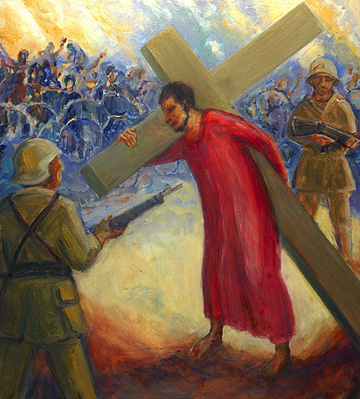
Jesus Takes Up His Cross
See the complete set of paintings at Church's "Anti-War" Paintings Draw Fire
As Christians, it seems that our duty is to dig deeper than the merely pragmatic concerns now being raised about the war in Iraq, valid as these may be. Our first concern should not be success, but whether our national projects advance the Kingdom of God. No matter how successful or otherwise the war in Iraq might be, we should struggle against it if it contradicts that Kingdom and the laws that should govern it. Perhaps a few more words by John Howard Yoder might bring this point to it's head, "He who resorts to blows confesses he has no better arguments. Violence is weak not only in the motivation and the moral resources which keep out the enemy but cannot create a wholesome society. It can aggress but not defend; it can revolt but not build. It can eliminate a specific abuse but cannot bring social health. If a regime established by violence is to survive, this can only be by demonstrating its capacity to increase progressively the areas of freedom and of orderly legal process. The one thing you cannot do with bayonets, as the dictum has it, is to sit on them." John Howard Yoder, The Original Revolution: Essays on Christian Pacificism, Scottsdale, PA: Herald Press, 1971, p. 167. The failure in Iraq goes far deeper than incompetent execution. The spirit that prosecuted this enterprise emerged from a culture of death, as Pope John Paul II so often described it.
John Paul II's attitude toward this war can be fairly summed up in his statement made on January 13, 2003 in an address after the American Congress authorized the use of force, "NO TO WAR! War is not always inevitable. It is always a defeat for humanity." The culture of death in which this war was gestated can be characterized in the following passage from John Paul II's Gospel of Life, "This reality is characterized by the emergence of a culture which denies solidarity and in many cases takes the form of a veritable 'culture of death'. This culture is actively fostered by powerful cultural, economic and political currents which encourage an idea of society excessively concerned with efficiency." This is the culture that justifies war as long as it can be successfully spun, but turns against it and its promoters once they are perceived as ineffective. It then becomes painfully clear that it is the ineffectiveness that is condemned, not the naked aggression involved in invading a sovereign country based on lies. The Tribunal at Nuremberg stated, "To initiate a war of aggression, therefore, is not only an international crime; it is the supreme international crime differing only from other war crimes in that it contains within itself the accumulated evil of the whole." This is the evil that Christians should, in my opinion, be focused on, not the fact that the aggression is not going well. It would be far worse if this deeply sinful plan were actually working. I also see an analogy here with Yoder's insight that the church should rejoice in her weakness, that her duty is not to make the powerful more effective, that we Christians need "no longer hold ourselves to be morally or psychologically obligated to tailor or moral standards to the needs of the people who are running the world", or running it into the ground in the current situation.
Sunday, November 27, 2005
Contested Formation
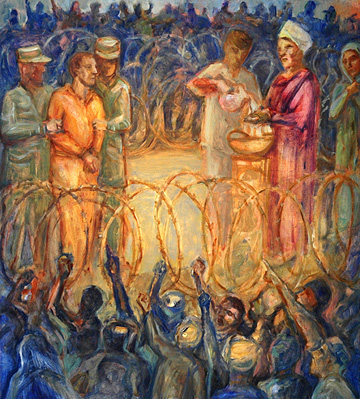
Jesus Condemned to Death
See the complete set of paintings at Church's "Anti-War" Paintings Draw Fire
On this first Sunday of Advent, may we peer carefully into our hearts to discern whom we are allowing to form them. Just as the Eucharist knits us into the Body of Christ and breaks down the isolation and alienation of consumer culture, so we constantly need to be alert to those social forces readying us for the slaughter. In the words of James, "Come now, you rich people, weep and wail for the miseries that are coming to you. Your riches have rotted and your clothes are moth-eaten. Your gold and silver have rusted, and their rust will be evidence against you, and it will eat your flesh like a fire. You have laid up treasure for the last days...You have lived on the earth in luxury and pleasure; you have fattened your hearts in a day of slaughter." James 5: 1-3, 5. The days of slaughter are upon us in Iraq. While churches looked the other way as Iraqis were offered up to knock a few cents off the gas price for our SUVs, we fatted our hearts. Our hearts grew encased in layer upon layer of lies and self-flattering images to which we gladly lent our ears and eyes. We know that we are being shaped, yet we are too flaccid to exercise the muscles that would form us in the image of Christ.
Most of us know where our real loyalty lies and it is not to the Church. In the words of a recent study, "...the church is (or should be) about being the new creation, a gathering of disciples that heralds the kingdom of God. As persons made in the image and likeness of God (Gen. 1:26), human beings ought not tbe formed into tools that serve lesser gods like the firm, but instead the full unfolding of the human person is realized in communion with Christ and the redemption of all creation. The church is meant to be God's social laboratory in the world, a prototype of human community that crosses all the world's divisions and holds together without killing and exploitation as its glue - as such it is meant to prefigure the kingdom of God, not a lean-production capitalist firm in which the few dominate and exploit the many inside and outside the firm." Michael Budde and Robert Brimlow, "Christianity Incorporated: How Big Business is Buying the Church, Grand Rapids, Mich.: Brazos Press, 2002.
Thursday, November 24, 2005
On Being Sheep
"As long as we are sheep, we overcome and, though surrounded by countless wolves, we emerge victorious; but if we turn into wolves, we are overcome, for we lose the shepherd's help. He, after all, feeds the sheep not wolves, and will abandon you if you do not let him show his power in you." St. John Chrysostom, Homily on St. Matthew.
St. John Chrysostom goes on to speak in the voice of Our Lord, "I could have managed things quite differently and sent you, not to suffer evil nor to yield like sheep to the wolves, but to be fiercer than lions. But the way I have chosen is right. It will bring you greater praise and at the same time manifest my power. That is what he told Paul: My grace is enough for you, for in weakness my power is made perfect."
St. John Chrysostom goes on to speak in the voice of Our Lord, "I could have managed things quite differently and sent you, not to suffer evil nor to yield like sheep to the wolves, but to be fiercer than lions. But the way I have chosen is right. It will bring you greater praise and at the same time manifest my power. That is what he told Paul: My grace is enough for you, for in weakness my power is made perfect."
Freedom of the Eucharist, pt. 2
To discover a sane alternative to the “myth of redemptive violence” which fuels the apparatus of the corporate state, we turn to St. Augustine, whose City of God draws the line between the practice of the Roman state and the laws that govern God’s city. As Rowan Williams puts it, Augustine “is engaged in a redefinition of the public itself, designed to show that it is life outside the Christian community which fails to be truly public, authentically political.” (Rowan Williams, “Politics and Soul: A Reading of the City of God,” Milltown Studies, no. 19/20: p. 58). The church does this not by the imposition of coercive power, but by means of sacrifice, not through the infliction of pain on other bodies, but through suffering our own pain in sympathy with that of others’. In the words of William Cavanaugh, “To participate in the Eucharist is to live inside God’s imagination. It is to be caught up into what is really real, the body of Christ…In the Eucharist, Christ sacrifices no other body but His own. Power is realized in self-sacrifice; Christians join in this sacrifice by uniting their own bodies to the sacrifice of Christ.” (Ibid, p. 279). Or in the words of Augustine, “This is the sacrifice of Christians: we, being many, are one body in Christ. And this also is the sacrifice which the Church continually celebrates in the sacrament of the altar, known to the faithful, in which she teaches that she herself is offered in the offering she makes to God.” (Augustine, The City of God, X, 6.) This is the true politics based in the sacrifice of the Eucharist, which embodies a power which is not power, “God chose what is low and despised in the world, things that are not, to reduce to nothing things that are.” (I Cor. 1: 28).
The face of Christ is not the face of satisfied wealth, a church fed fat off the suffering of billions, with its mouth taped shut in the face of an illegal war inscribed with the lie that “everything changed after 9/11.” By assuming the church’s interest in political matters to be confined to issues of personal sin such as sexual morality and personal responsibility defined as if current economic structures were simply a unquestionable given, such churches well fulfill the role designated for them by the corporate state, that of “chaplains to capitalism.” Such a church is far different from the one that emerged during the persecutions of the Roman Empire or the Chilean dictatorship, when Christians believed “that there exist mysterious channels which can make the solidarity of friends reach those who languish in the deepest dungeons…those who are being tortured are united in the tortured body of Christ. ‘Conditioned by the knowledge of those “mysterious channels”, their bodies are transformed into powerful flesh for the sacrifice in which they lovingly commune [comulgan, receive the Eucharist] with those who suffer.” (Ibid., p. 277).
God does not empower those who imprison detainees in neoliberal dungeons which let us play sick videogames in the state’s imagination. God’s power is not found in the technology of pain and death, nor can His purposes be advanced by it. The screams of the victims of Abu Ghraib, Bagram, Guantanamo, and the newly revived gulags of Eastern Europe are the screams of our Lord, who died to bring us a new discipline, one that breaks the disarticulation of the individual which optimizes the conditions for corporate profits. In opposition to a church that exudes the spirituality of what John Paul II described as the “culture of death”, resistance to the powers that thrive on the myth of redemptive violence is built into the sufferings of the cross, and embodied in the bread that knits us into the body of Christ. In the words of William Cavanaugh, “The true ‘discipline of the secret’ calls Christians to become the true body of Christ, and bring to light the suffering of others by making that suffering visible in their own bodies.” (Ibid., p. 281). This commitment is deep as the commitment to our own bodies, whose silence is complicity with the torturers, those whose non-negotiable need for comfort and security justifies the pain of those in whom He lives.
Addendum:
The litany of torture techniques used in Chile, with the exception of electric shock, though instances of that in the current Iraq conflict are documented as well, closely resemble those in Rumsfeld’s memo posted on a column outside Cellblock 1A in Abu Ghraib, as described by Colonel Janis Karpinski, “it discussed interrogation techniques that were authorized. It was one page. It talked about stress positions, noise and light discipline, the use of music, disrupting sleep patterns, those kind of techniques.” (Democracy Now!, Interview with Col. Janis Karpinski, Oct. 26, 2005). By the way, I don’t think the current administration is literally copying the techniques used in Chile and other Latin American countries during the 70’s and 80’s. If anything, the Chileans probably learned the techniques from us, trained as they were in the School of the Americas, but I argue merely that similar goals often call for similar means: the goal in this case being the opening of the Middle East to economic liberalization.
The face of Christ is not the face of satisfied wealth, a church fed fat off the suffering of billions, with its mouth taped shut in the face of an illegal war inscribed with the lie that “everything changed after 9/11.” By assuming the church’s interest in political matters to be confined to issues of personal sin such as sexual morality and personal responsibility defined as if current economic structures were simply a unquestionable given, such churches well fulfill the role designated for them by the corporate state, that of “chaplains to capitalism.” Such a church is far different from the one that emerged during the persecutions of the Roman Empire or the Chilean dictatorship, when Christians believed “that there exist mysterious channels which can make the solidarity of friends reach those who languish in the deepest dungeons…those who are being tortured are united in the tortured body of Christ. ‘Conditioned by the knowledge of those “mysterious channels”, their bodies are transformed into powerful flesh for the sacrifice in which they lovingly commune [comulgan, receive the Eucharist] with those who suffer.” (Ibid., p. 277).
God does not empower those who imprison detainees in neoliberal dungeons which let us play sick videogames in the state’s imagination. God’s power is not found in the technology of pain and death, nor can His purposes be advanced by it. The screams of the victims of Abu Ghraib, Bagram, Guantanamo, and the newly revived gulags of Eastern Europe are the screams of our Lord, who died to bring us a new discipline, one that breaks the disarticulation of the individual which optimizes the conditions for corporate profits. In opposition to a church that exudes the spirituality of what John Paul II described as the “culture of death”, resistance to the powers that thrive on the myth of redemptive violence is built into the sufferings of the cross, and embodied in the bread that knits us into the body of Christ. In the words of William Cavanaugh, “The true ‘discipline of the secret’ calls Christians to become the true body of Christ, and bring to light the suffering of others by making that suffering visible in their own bodies.” (Ibid., p. 281). This commitment is deep as the commitment to our own bodies, whose silence is complicity with the torturers, those whose non-negotiable need for comfort and security justifies the pain of those in whom He lives.
Addendum:
The litany of torture techniques used in Chile, with the exception of electric shock, though instances of that in the current Iraq conflict are documented as well, closely resemble those in Rumsfeld’s memo posted on a column outside Cellblock 1A in Abu Ghraib, as described by Colonel Janis Karpinski, “it discussed interrogation techniques that were authorized. It was one page. It talked about stress positions, noise and light discipline, the use of music, disrupting sleep patterns, those kind of techniques.” (Democracy Now!, Interview with Col. Janis Karpinski, Oct. 26, 2005). By the way, I don’t think the current administration is literally copying the techniques used in Chile and other Latin American countries during the 70’s and 80’s. If anything, the Chileans probably learned the techniques from us, trained as they were in the School of the Americas, but I argue merely that similar goals often call for similar means: the goal in this case being the opening of the Middle East to economic liberalization.
Friday, November 18, 2005
Freedom of the Eucharist
Torture seeks to script our bodies into a drama of fear, to place the mark of the state upon us so that we willingly accept our slavery to its purposes. The Eucharist breaks the drama of fear and gives birth to the freedom of the sons of God, not by the domination of a material counter-power to the power of the state, but through the “weakness” of love. “Because the foolishness of God is wiser than men, and the weakness of God is stronger than men.” (I Corinthians 1:25). This weakness is stronger than the power of the state, and requires a deeper discipline than the discipline of torture.
What we believe was born in pain, the pain of Jesus on the cross. Those who torture Iraqis seek to isolate them in their pain, to disarticulate the victim’s bonds to others, those intermediate social bodies which would challenge the new state power that seeks to extend its neoliberal grip. In their suffering, we can see the face of the suffering Jesus, just as “the theologian Jose Aldunate says, ‘Torture is the most vehement attack against the body of Christ’; according to Aldunate, it is Christ himself who is tortured.” (William T. Cavanaugh. Torture and Eucharist: Theology, Politics, and the Body of Christ. Oxford: Blackwell Publishing, 1998. p. 257). Torture removes the intervening layers of society that buffer the individual from its raw power. The sexual humiliation which we witnessed in the photos from Abu Ghraib represent a technique that has been refined over decades, particularly in Latin America, which induces the degradation necessary to force acceptance of the state’s drama of power. “The goal of torture, in effect is to produce the acceptance of a state discourse, through the confession of putrescence.” (quoted in the study referenced above on p. 31). Far from simply being a desperate attempt to wrest information from unwilling subversives, “We misunderstand modern torture, however, if we fail to see that enemies of the regime are not so much punished as produced in the torture chamber. Torture does not uncover and penalize a certain type of discourse, but rather creates a discourse of its own and uses it to realize the state’s claims to power over the bodies of its citizens.” (Ibid, p. 31). This is not sadism or “stress relief”, it is science, a carefully refined tool used to fragment all social sources of identity other than the corporate state, a mode of governance which targets the springs of spiritual identity, as we see in the desecration of the Koran, just as Pinochet targeted the Church in Chile.
What torture represents in its extreme form, the disintegration and disappearance of all that rivals the corporate state, inhabits the society that practices it as a pervasive atmosphere of fear and fragmentation. What is remarkable about the post 9/11 era is how disciplined the “coalition of the willing” has been in “scripting our bodies into a drama of fear.” (Ibid, p. 33). Their purpose is not directly to repress, but to induce a sense of chaos from which they can rescue us, to produce the drama of a new era, in which “everything has changed”, most notably the rules against “cruel, unusual, and inhumane treatment.”
The society that enters into this drama is one in which intermediate organizations, churches, unions, parties, those units of what the Catholic Church calls subsidiarity, which as originally articulated in Pope Pius XI’s encyclical, Quadragesimo Anno, counter the “…injustice and at the same time a grave evil and disturbance of right order” that assigns “to a greater and higher association what lesser and subordinate organizations can do. For every social activity ought of its very nature to furnish help to the members of the body social, and never destroy and absorb them.” QA, paragraph 79. After the fall of Baghdad, Bremer’s economic policies were described by Joseph Stiglitz, Nobel laureate and former chief economist at the World Bank, as “an even more radical form of shock therapy than pursued in the former Soviet world” (Klein, Naomi, “Baghdad Year Zero”, Harper’s Magazine, Sept. 24, 2004.) The same form of “shock treatment” required similar social measures in Chile during the 1970’s, as “Los Chicago Boys”, Milton Friedman and his fellow travelers, were called upon to restructure that economy. The all-too-familiar results, atomized unions and soaring unemployment arise from an ideology in which “only individuals can have moral obligations”, in the words of Friedman (Milton Friedman, “Good Ends, Bad Means” in the Catholic Challenge to the American Economy, ed. Thomas M. Gannon, S.J. New York: Macmillan Publishing, 1987, p. 105). To support such “therapy”, an economic “grill” was needed. In Chile, a detainee described the “grill” as follows: “…immediately I was taken to the torture chamber. There they made me undress and with my hands and feet tied to the metal frame of the lower part of a bunkbed they began to apply electric current to me. This is the ‘grill.’” (Ibid, p. 24). This “grilling” was the logical counterpart to the “shock” to the economy applied by the Chilean dictatorship and almost exactly parallel to the one ordered by Paul Bremer in Iraq. Torture can effectively aid the required atomization of society. “The disarticulation of worker’s organizations through the strategy of torture was an essential component of the neoliberal economic model imposed in Chile and other Latin American countries.” (Ibid., p. 39).
What we believe was born in pain, the pain of Jesus on the cross. Those who torture Iraqis seek to isolate them in their pain, to disarticulate the victim’s bonds to others, those intermediate social bodies which would challenge the new state power that seeks to extend its neoliberal grip. In their suffering, we can see the face of the suffering Jesus, just as “the theologian Jose Aldunate says, ‘Torture is the most vehement attack against the body of Christ’; according to Aldunate, it is Christ himself who is tortured.” (William T. Cavanaugh. Torture and Eucharist: Theology, Politics, and the Body of Christ. Oxford: Blackwell Publishing, 1998. p. 257). Torture removes the intervening layers of society that buffer the individual from its raw power. The sexual humiliation which we witnessed in the photos from Abu Ghraib represent a technique that has been refined over decades, particularly in Latin America, which induces the degradation necessary to force acceptance of the state’s drama of power. “The goal of torture, in effect is to produce the acceptance of a state discourse, through the confession of putrescence.” (quoted in the study referenced above on p. 31). Far from simply being a desperate attempt to wrest information from unwilling subversives, “We misunderstand modern torture, however, if we fail to see that enemies of the regime are not so much punished as produced in the torture chamber. Torture does not uncover and penalize a certain type of discourse, but rather creates a discourse of its own and uses it to realize the state’s claims to power over the bodies of its citizens.” (Ibid, p. 31). This is not sadism or “stress relief”, it is science, a carefully refined tool used to fragment all social sources of identity other than the corporate state, a mode of governance which targets the springs of spiritual identity, as we see in the desecration of the Koran, just as Pinochet targeted the Church in Chile.
What torture represents in its extreme form, the disintegration and disappearance of all that rivals the corporate state, inhabits the society that practices it as a pervasive atmosphere of fear and fragmentation. What is remarkable about the post 9/11 era is how disciplined the “coalition of the willing” has been in “scripting our bodies into a drama of fear.” (Ibid, p. 33). Their purpose is not directly to repress, but to induce a sense of chaos from which they can rescue us, to produce the drama of a new era, in which “everything has changed”, most notably the rules against “cruel, unusual, and inhumane treatment.”
The society that enters into this drama is one in which intermediate organizations, churches, unions, parties, those units of what the Catholic Church calls subsidiarity, which as originally articulated in Pope Pius XI’s encyclical, Quadragesimo Anno, counter the “…injustice and at the same time a grave evil and disturbance of right order” that assigns “to a greater and higher association what lesser and subordinate organizations can do. For every social activity ought of its very nature to furnish help to the members of the body social, and never destroy and absorb them.” QA, paragraph 79. After the fall of Baghdad, Bremer’s economic policies were described by Joseph Stiglitz, Nobel laureate and former chief economist at the World Bank, as “an even more radical form of shock therapy than pursued in the former Soviet world” (Klein, Naomi, “Baghdad Year Zero”, Harper’s Magazine, Sept. 24, 2004.) The same form of “shock treatment” required similar social measures in Chile during the 1970’s, as “Los Chicago Boys”, Milton Friedman and his fellow travelers, were called upon to restructure that economy. The all-too-familiar results, atomized unions and soaring unemployment arise from an ideology in which “only individuals can have moral obligations”, in the words of Friedman (Milton Friedman, “Good Ends, Bad Means” in the Catholic Challenge to the American Economy, ed. Thomas M. Gannon, S.J. New York: Macmillan Publishing, 1987, p. 105). To support such “therapy”, an economic “grill” was needed. In Chile, a detainee described the “grill” as follows: “…immediately I was taken to the torture chamber. There they made me undress and with my hands and feet tied to the metal frame of the lower part of a bunkbed they began to apply electric current to me. This is the ‘grill.’” (Ibid, p. 24). This “grilling” was the logical counterpart to the “shock” to the economy applied by the Chilean dictatorship and almost exactly parallel to the one ordered by Paul Bremer in Iraq. Torture can effectively aid the required atomization of society. “The disarticulation of worker’s organizations through the strategy of torture was an essential component of the neoliberal economic model imposed in Chile and other Latin American countries.” (Ibid., p. 39).
Sunday, November 13, 2005

Melting Skin for Peace
In case you haven't been following the white phosphorous controversy, there are two facts that most news coverage is completely missing. First, the accusations of white phosphorous usage are not new, but were documented at the time of the second attack on Fallujah by unembedded journalist Dahr Jamail based on interviews with Fallujah refugees. These facts were commented on rather extensively here at Nonviolent Jesus. Secondly, and this is what should aid any anti-war actions or speeches that your group may be carrying out - the Army has admitted that it uses white phosphorous as a weapon. Here is the relevant section from the March Field Artillery magazine: "WP [i.e., white phosphorus rounds] proved to be an effective and versatile munition. We used it for screening missions at two breeches and, later in the fight, as a potent psychological weapon against the insurgents in trench lines and spider holes when we could not get effects on them with HE. We fired 'shake and bake' missions at the insurgents, using WP to flush them out and HE to take them out."
The Italian film from RAI which can be viewed here: http://movies.crooksandliars.com/fallujah_ING~1.wmv extensively documents the weapons use with eye-witness accounts. In fact, if you look at the material collected by Daily Kos, http://www.dailykos.com/tag/White%20phosphorus, it's clear that even at the time, such radical left-wing publications as the Washington Post documented the use of white phosphorous as a weapon, which the Army did not dispute at the time.
White phosphorous is a weapon of terror, which burns the skin of its victims to the bone and can't be extinguished with water. The teaching of the Church on operations such as razing the city of Fallujah and treating every person in the city as an insurgent is clear: "Every act of war directed to the indiscriminate destruction of whole cities or vast areas with their inhabitants is a crime against God and man, which merits firm and unequivocal condemnation. A danger of modern warfare is that it provides the opportunity to those who possess modern scientific weapons-especially atomic, biological, or chemical weapons- to commit such crimes." Catechism of the Catholic Church, paragraph 2314.
I have to admit I'm often afraid that I'm speaking to the void, a voice crying in the wilderness that no one hears. Yes, there are blogs that speak about these things, but hardly ever from a Christian perspective. Where are my fellow brothers and sisters in Christ who see Christ's face in the massacred inhabits of Fallujah? Where is the outrage among Catholic bishops over the destruction of a city and the use of chemical weapons to melt away the skin of innocent men, women, and children? Yes, there will probably be commission one day that will conclude, long after the witnesses of the time have died or moved on, that perhaps it was a crime that was committed in 2004. Why were these voices silent in the year 2004 when they might have saved a life or two?
The Italian film from RAI which can be viewed here: http://movies.crooksandliars.com/fallujah_ING~1.wmv extensively documents the weapons use with eye-witness accounts. In fact, if you look at the material collected by Daily Kos, http://www.dailykos.com/tag/White%20phosphorus, it's clear that even at the time, such radical left-wing publications as the Washington Post documented the use of white phosphorous as a weapon, which the Army did not dispute at the time.
White phosphorous is a weapon of terror, which burns the skin of its victims to the bone and can't be extinguished with water. The teaching of the Church on operations such as razing the city of Fallujah and treating every person in the city as an insurgent is clear: "Every act of war directed to the indiscriminate destruction of whole cities or vast areas with their inhabitants is a crime against God and man, which merits firm and unequivocal condemnation. A danger of modern warfare is that it provides the opportunity to those who possess modern scientific weapons-especially atomic, biological, or chemical weapons- to commit such crimes." Catechism of the Catholic Church, paragraph 2314.
I have to admit I'm often afraid that I'm speaking to the void, a voice crying in the wilderness that no one hears. Yes, there are blogs that speak about these things, but hardly ever from a Christian perspective. Where are my fellow brothers and sisters in Christ who see Christ's face in the massacred inhabits of Fallujah? Where is the outrage among Catholic bishops over the destruction of a city and the use of chemical weapons to melt away the skin of innocent men, women, and children? Yes, there will probably be commission one day that will conclude, long after the witnesses of the time have died or moved on, that perhaps it was a crime that was committed in 2004. Why were these voices silent in the year 2004 when they might have saved a life or two?
Saturday, November 05, 2005
What We Have Lost
The Bush administration is now seeking to openly justify the torture it has carried on semi-clandestinely for the past three years. This represents one of the few innovations that the current administration has managed to achieve. The wise inhibitions of our forefathers regarding torture are now being shed, and the fact that it is being done by those who wear their evangelical faith on their sleeve, if not their forehead, makes it all the more disheartening to those of us who struggle to follow the non-torturing Jesus. The silence of the mainstream churches in the face of this blatant violation of God's image is one more sad argument that they have indeed become mere "chaplains of capitalism" as a recent study Christianity Incorporated by Micheal Budde has argued.
" In an interview for National Public Radio he (Colonel Lawrence Wilkerson, Colin Powell's chief of staff) charged that Vice President Cheney's office--and new chief aide David Addingtoon--was responsible for directives which led to U.S soldiers abusing prisoners in Iraq and Afghanistan.
Wilkerson said he had some hard evidence: a trail of memos and directives authorizing questionable detention practices up through Secretary of Defense Donald Rumsfeld's office directly to Cheney's staff. The directives, he said, contradicted a 2002 order by President Bush for the military to abide by the Geneva Convention rules against torture." - "More Fodder for Press: Wilkerson Charges Cheney Responsible for Prisoner Abuse", AP, Nov. 4 , 2005.
In direct support of his contentions, Cheney is currently making direct personal appeals to endorse "cruel, inhuman, and degrading treatment" of detainees. "Vice President Dick Cheney made an unusual personal appeal to Republican senators this week to allow exemptions to a proposed ban on the torture of terror suspects in U.S. custody, according o participants in a closed-door session." "Cheney Seeks CIA Exemption to Torture Ban", AP, Nov. 5, 2005. This Christian uses his power not to seek comfort for those souls who have fallen into his clutches, but open and unprecedented freedom to degrade and torture them without limit or oversight. Not even Pinochet's Chile demanded such an open right.
Yet still the silence of the churches continues. Let us pray that we might be forgiven our own silence and inaction while our brothers and sisters are tortured to keep us safe.
" In an interview for National Public Radio he (Colonel Lawrence Wilkerson, Colin Powell's chief of staff) charged that Vice President Cheney's office--and new chief aide David Addingtoon--was responsible for directives which led to U.S soldiers abusing prisoners in Iraq and Afghanistan.
Wilkerson said he had some hard evidence: a trail of memos and directives authorizing questionable detention practices up through Secretary of Defense Donald Rumsfeld's office directly to Cheney's staff. The directives, he said, contradicted a 2002 order by President Bush for the military to abide by the Geneva Convention rules against torture." - "More Fodder for Press: Wilkerson Charges Cheney Responsible for Prisoner Abuse", AP, Nov. 4 , 2005.
In direct support of his contentions, Cheney is currently making direct personal appeals to endorse "cruel, inhuman, and degrading treatment" of detainees. "Vice President Dick Cheney made an unusual personal appeal to Republican senators this week to allow exemptions to a proposed ban on the torture of terror suspects in U.S. custody, according o participants in a closed-door session." "Cheney Seeks CIA Exemption to Torture Ban", AP, Nov. 5, 2005. This Christian uses his power not to seek comfort for those souls who have fallen into his clutches, but open and unprecedented freedom to degrade and torture them without limit or oversight. Not even Pinochet's Chile demanded such an open right.
Yet still the silence of the churches continues. Let us pray that we might be forgiven our own silence and inaction while our brothers and sisters are tortured to keep us safe.
Abandonment of the Poor
At the risk of being a bit stark, I would say that if you don't care about the poor, then you might as well stop attempting to call yourself a Christian. Of course, virtually all of our Christian brothers claim that they do care about the poor. But caring about the poor can't be merely theoretical. For many neocon Christians, their faith tells them that the best way to help the poor is not by actually doing anything to lighten the burdens of the poor. That, they fear, would only reinforce their sinful tendencies and further loosen the discipline that has brought them to their plight. No, much as it might wound their delicate consciences, they must increase those burdens so that the poor might build the character which is the true ticket to respect. In other words, we help the poor not by actually helping them, but by making their lives so miserable that they become like us.
Of course, many types of addiction are widespread in this society for rich and poor. Along these lines, I would like to suggest a definition for the poor: first, there are the economic poor, in the Gospels, those who hunger and thirst, the sick, those in prison, and so on. Secondly, there are those despised by the ruling society: sinners, publicans, prostitutes, who are not necessarily economically oppressed, but denied dignity. These two usually converge in our society. The self-righteous Christianity I've been critiquing here says that the poor are in the state they are in because they lack the motivation and self-discipline to raise themselves up. Drug addiction is part of the syndrome that causes their poverty. It results from repeated, morally culpable self-indulgence that leads to enslavement to drugs. Part of the good news that Jesus came to bring might be that the lack of dignity and self-esteem which drive the poor (and rich) to this enslavement is not only the result of personal sin, but also social sin that reinforces negative self-images in order to encourage an economically lucrative indulgence.
Of course, many types of addiction are widespread in this society for rich and poor. Along these lines, I would like to suggest a definition for the poor: first, there are the economic poor, in the Gospels, those who hunger and thirst, the sick, those in prison, and so on. Secondly, there are those despised by the ruling society: sinners, publicans, prostitutes, who are not necessarily economically oppressed, but denied dignity. These two usually converge in our society. The self-righteous Christianity I've been critiquing here says that the poor are in the state they are in because they lack the motivation and self-discipline to raise themselves up. Drug addiction is part of the syndrome that causes their poverty. It results from repeated, morally culpable self-indulgence that leads to enslavement to drugs. Part of the good news that Jesus came to bring might be that the lack of dignity and self-esteem which drive the poor (and rich) to this enslavement is not only the result of personal sin, but also social sin that reinforces negative self-images in order to encourage an economically lucrative indulgence.
Subscribe to:
Posts (Atom)
